
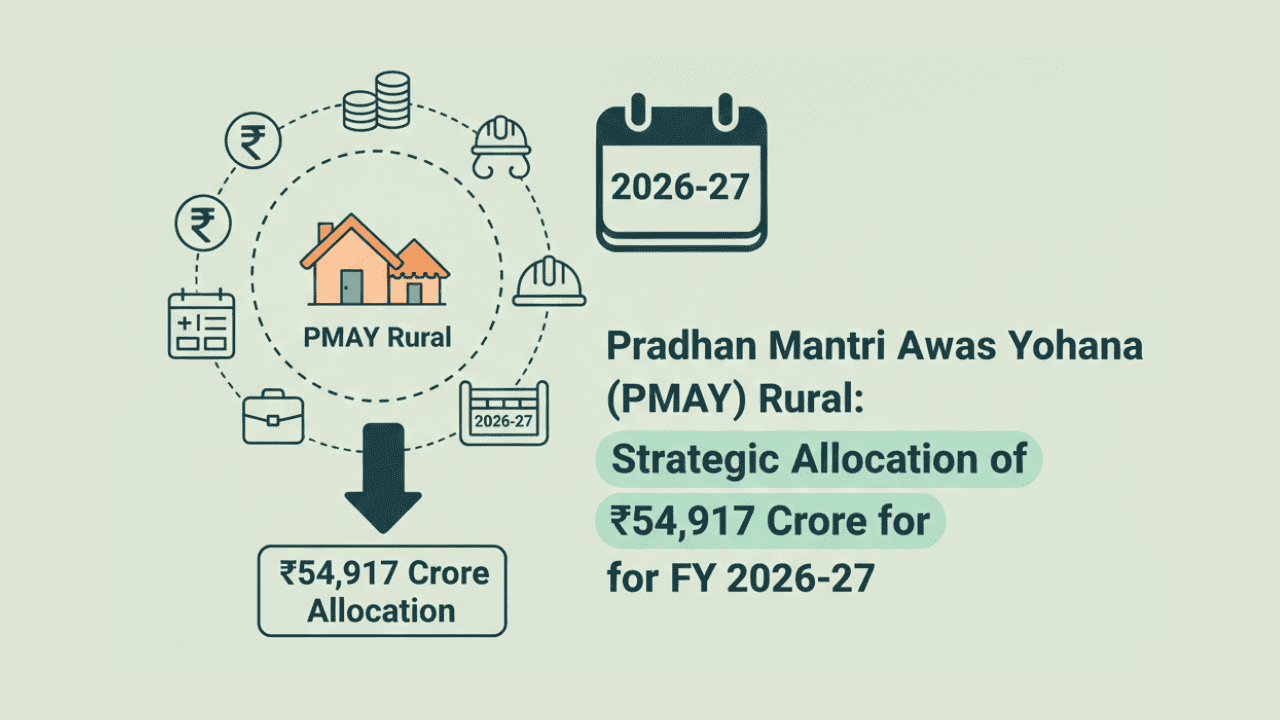
In a move to accelerate the “Housing for All” mission, the Government of India has announced a substantial fiscal commitment of ₹54,917 crore for the Pradhan Mantri Awas Yojana-Gramin (PMAY-G) for the financial year 2026-27. This strategic allocation, unveiled as part of the Union Budget 2026-27, reflects a significant 69% increase over the previous year’s revised estimates. The Prime Minister, in his post-budget address, emphasized that this funding is not merely a budgetary figure but a “foundational pillar” for rural dignity and economic resilience. As India moves into the second phase of the scheme, the focus has shifted toward completing a cumulative target of 4.95 crore rural houses by March 2029, ensuring that the most vulnerable households in the remotest corners of the country are transitioned from temporary “kutcha” structures to permanent, all-weather “pucca” homes.
The ₹54,917 crore outlay is part of a broader ₹3.06 lakh crore financial framework approved for the construction of an additional 2 crore houses between 2024 and 2029. By prioritizing rural housing, the government aims to stimulate the rural economy, creating millions of man-days of employment and driving demand in the core sectors of cement, steel, and bricks. This phase of PMAY-G is specifically tailored to address the evolving needs of rural India, integrating modern technology with traditional construction practices to build homes that are not only durable but also climate-resilient and energy-efficient.
Strategic Objectives of PMAY-G Phase 2
The 2026-27 allocation is designed to operationalize the second phase of the rural housing mission, which introduces several key reforms in beneficiary selection and house design. While the first phase relied heavily on the 2011 Socio-Economic Caste Census (SECC) data, the current phase utilizes the Awas+ 2024 survey to identify eligible families that may have been left behind.
A primary objective of this year’s funding is the 100% saturation of Particularly Vulnerable Tribal Groups (PVTGs) under the PM-JANMAN vertical. These communities, often located in the most geographically challenged terrains, are being provided with enhanced unit assistance to account for higher logistical costs. Furthermore, the government has mandated that 60% of the total targets at the state level must be earmarked for Scheduled Castes (SC) and Scheduled Tribes (ST), ensuring that the benefits of the scheme are distributed equitably among the most deprived sections of the rural population.
Financial Assistance and Convergence Model
The financial structure of PMAY-G for FY 2026-27 continues to follow a robust “convergence model,” where the core housing grant is supplemented by other social welfare schemes to provide a holistic living environment. Each beneficiary in plain areas receives a direct assistance of ₹1.20 lakh, while those in hilly states, North Eastern regions, and difficult terrains (including LWE-affected districts) receive ₹1.30 lakh.
However, the effective value of the assistance is significantly higher due to the integration of various government programs:
- Swachh Bharat Mission (SBM-G): An additional ₹12,000 is provided for the construction of a dedicated household toilet.
- MGNREGS Integration: Every PMAY-G beneficiary is entitled to 90 to 95 days of unskilled labor wages, providing an additional financial cushion of approximately ₹27,000 to ₹30,000 toward construction costs.
- Access to Clean Energy: Through the PM-Surya Ghar Muft Bijli Yojana and Ujjwala Yojana, every new home is equipped with solar rooftop potential and a clean cooking gas connection.
- Jal Jeevan Mission: The funding ensures that every sanctioned house is pre-connected to a functional household tap connection (FHTC) for clean drinking water.
For families wishing to expand their homes beyond the minimum mandated size of 25 square meters, the government facilitates access to institutional finance up to ₹70,000 at subsidized interest rates. This multi-layered financial support ensures that rural families do not fall into a debt trap while building their permanent assets.
Empowering Women through Ownership
One of the most transformative features of PMAY-G 2.0, supported by the 2026 budget, is the mandatory push for women-centric ownership. The Ministry of Rural Development has notified that all houses sanctioned under the new phase must be registered in the name of the female head of the household or in joint ownership with the husband. As of early 2026, over 74% of PMAY-G homes are already owned or co-owned by women.
This policy shift is intended to enhance the social status of women in rural society and provide them with a sense of financial security and agency. By creating a permanent asset in their name, the government is fostering long-term behavioral changes regarding gender equity in rural property rights. The Prime Minister has reiterated that “Nari Shakti” (Women Power) is the driving force behind the Viksit Bharat vision, and a home in a woman’s name is the first step toward true empowerment.
Transparency and Digital Governance
To ensure that every rupee of the ₹54,917 crore allocation reaches the intended beneficiary, the PMAY-G scheme relies on an end-to-end digital governance model. The AwaasSoft and AwaasApp platforms serve as the backbone of the mission’s transparency.
- Direct Benefit Transfer (DBT): All payments are made directly into the Aadhaar-linked bank accounts of the beneficiaries in installments, linked to the physical progress of the house.
- Geo-Tagging: Construction progress is monitored through geo-tagged, time-stamped photographs at every stage—from the foundation and lintel level to completion.
- Social Audits: The government has mandated annual social audits in every Gram Panchayat to allow the community to verify the quality of construction and the legitimacy of the beneficiary list.
This tech-driven approach has significantly reduced the “leakage” of funds and eliminated the role of middlemen, ensuring a higher completion rate and better quality of housing. For the 2026-27 cycle, the NHA has also introduced AI-based monitoring to detect anomalies in construction patterns across different states, allowing for real-time course correction.
Conclusion: Strengthening the Rural Foundation
The strategic allocation of ₹54,917 crore for PMAY-Rural in FY 2026-27 is a testament to the government’s unwavering commitment to the rural poor. By providing a “pucca” roof over every head, the mission is addressing one of the most fundamental requirements for human development. These homes are more than just brick-and-mortar structures; they are symbols of social mobility, health, and security.
As the “Reform Express” gains momentum, the success of PMAY-G will be a defining factor in achieving the goal of a developed India by 2047. Through the convergence of multiple welfare schemes and a focus on women’s empowerment, the government is not just building houses, but is building a stronger, more resilient rural society. The path to Viksit Bharat passes through the villages of India, and with this enhanced fiscal support, that path is now being paved with permanent homes and bright futures for millions.