
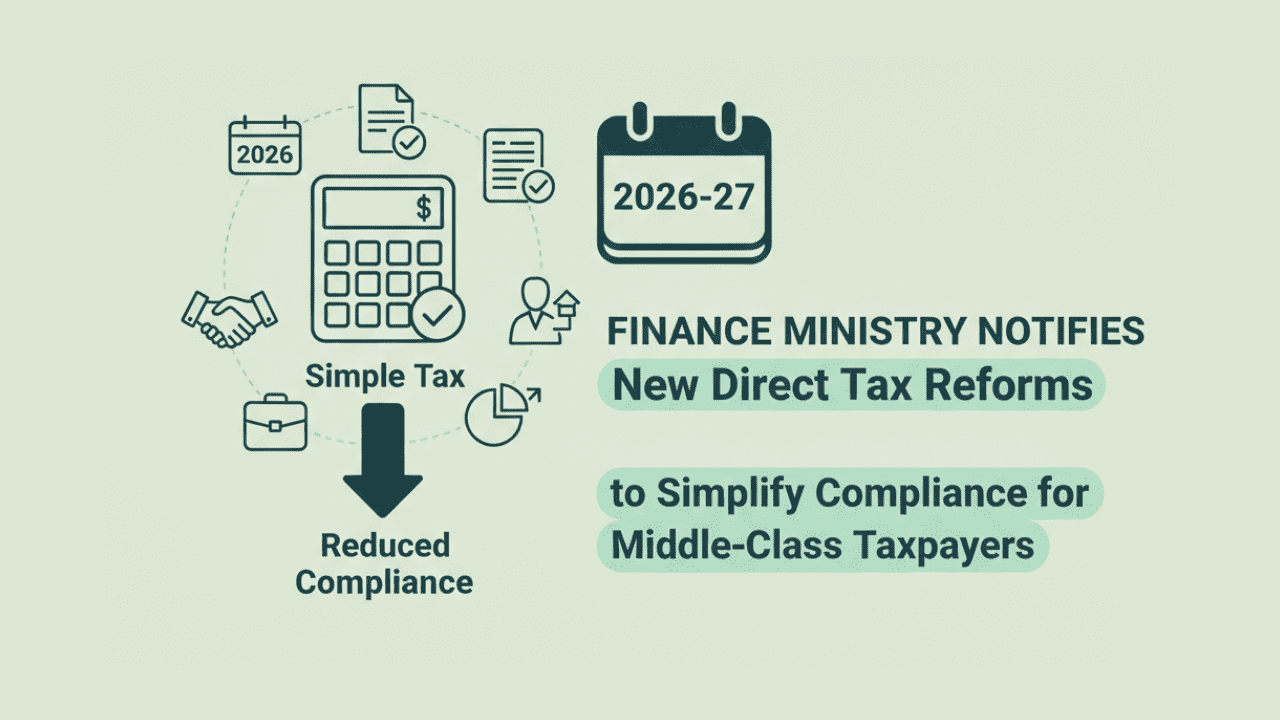
NEW DELHI – In a move that signals the beginning of a new era in Indian fiscal policy, the Ministry of Finance has officially notified a series of sweeping direct tax reforms aimed at fundamentally altering the relationship between the taxpayer and the state. Following the roadmap laid out in the Union Budget 2026-27, these reforms are centered on the upcoming implementation of the Income Tax Act, 2025, which is set to replace the decades-old 1961 legislation on April 1, 2026. The notification serves as a formal commitment to the “Ease of Living” for the middle class, prioritizing simplified compliance, digital-first interactions, and a significant reduction in the complexity that has historically burdened individual taxpayers.
The primary objective of these reforms is to foster a “trust-based” tax ecosystem. By stripping away redundant sections and archaic legal prose, the government intends to make tax filing a routine, stress-free activity rather than an annual source of anxiety. The Finance Ministry has emphasized that these changes are not merely cosmetic; they represent a structural shift toward a data-driven, faceless administration that rewards honest taxpayers with speed and transparency. As the “Reform Express” gains momentum, the middle class stands at the forefront of this transition, benefiting from higher exemption limits and an intuitive filing experience.
The Sunset of the 1961 Act and the Dawn of 2025
The notification provides the first detailed glimpse into the structure of the Income Tax Act, 2025. For over sixty years, the 1961 Act served as the bedrock of Indian taxation, but its countless amendments and labyrinthine clauses had become a barrier to voluntary compliance. The new Act has been condensed and rewritten in plain language, reducing the total number of sections by nearly 25%. This “Clean Code” approach is designed to eliminate ambiguity, which has been the primary driver of tax litigation in India.
One of the most significant changes notified is the standardization of the “Tax Year” across all categories of income. This move synchronizes timelines for salary, business income, and capital gains, making it easier for taxpayers to consolidate their financial records. Furthermore, the Finance Ministry has introduced a “Compliance Score” system for taxpayers. Individuals who consistently file on time and maintain accurate records will be fast-tracked for refunds and will face significantly lower odds of being selected for automated scrutiny. This “nudge” toward compliance is a core pillar of the government’s strategy to expand the tax base without resorting to aggressive enforcement.
Enhanced Slabs and the Logic of the New Tax Regime
The notification reinforces the government’s push to make the New Tax Regime the primary choice for the Indian middle class. To achieve this, the Ministry has clarified the tax slabs for the upcoming fiscal year, designed to maximize disposable income for those in the middle-income bracket.
Under the notified rules, the threshold for zero tax liability has been effectively raised through a combination of revised slabs and the Section 87A rebate. For the salaried class, the standard deduction has been increased to ₹75,000, ensuring that an individual earning up to ₹12.75 lakh annually pays no tax under the New Regime. This strategic adjustment is intended to act as a massive fiscal stimulus for the middle class, encouraging consumption and investment in the domestic economy. The Ministry’s data suggests that these reforms will put an additional ₹25,000 to ₹40,000 back into the pockets of the average middle-class household every year.
Digital Transformation: The “Smart ITR” and Pre-filled Forms
A key highlight of the notification is the full-scale deployment of “Smart ITR” forms. Starting from the April 2026 filing season, the traditional, lengthy ITR forms will be replaced by dynamic, AI-enabled questionnaires. These forms will adapt in real-time based on the taxpayer’s profile. For instance, if a taxpayer has no income from house property, the entire section will remain hidden, preventing confusion.
The integration of the Annual Information Statement (AIS) has been deepened. The government has notified that all major financial institutions, including banks, mutual fund houses, and stock exchanges, will now feed data directly into the tax portal with 99% accuracy. This means that when a taxpayer logs in to file their return, nearly 80% of the data—including salary, dividends, interest income, and even share sales—will be pre-filled. The role of the taxpayer will shift from “data entry” to “data verification,” a move that is expected to reduce filing time from hours to a mere few minutes.
Simplifying Capital Gains and Deterring Speculation
The direct tax reforms also address the long-standing demand for the rationalization of capital gains tax. The Ministry has notified a simplified two-tier structure for capital gains:
- Short-Term Capital Gains (STCG): Held for less than 12 months for listed assets and 24 months for unlisted assets, taxed at the individual’s slab rate.
- Long-Term Capital Gains (LTCG): Taxed at a flat 12.5% for all asset classes, with an increased exemption limit of ₹2 lakh per year.
While simplifying the structure for long-term investors, the government remains cautious about excessive speculation in the derivatives market. The notification confirms an increase in the Securities Transaction Tax (STT) on Futures and Options (F&O). This is a deliberate policy choice to protect retail investors from the high risks of intraday trading and to redirect capital toward more productive, long-term investments in the Indian equity markets.
Relief for Seniors and Streamlined Dispute Resolution
Senior citizens receive substantial attention in the new reforms. The notification doubles the deduction for interest income under Section 80TTB from ₹50,000 to ₹1,00,000, providing a significant boost to retirees who depend on fixed-income instruments. Additionally, the age for “Super Senior” status, which carries even higher benefits, has been rationalized to ensure more citizens can avail of maximum relief as they age.
To reduce the burden of existing disputes, the Finance Ministry has notified a “Fast-Track Rectification” window. For small-scale discrepancies involving amounts up to ₹50,000, the system will allow for automated corrections without the need for an Assessing Officer’s intervention. This “Faceless Resolution” mechanism is expected to clear over 5 lakh pending minor cases within the first six months of the new Act’s implementation, freeing up the department to focus on high-value enforcement.
Conclusion: A Covenant of Trust
The notification of these direct tax reforms marks a pivotal moment in India’s journey toward a developed nation status. By focusing on the middle class—the engine of the Indian economy—the Finance Ministry is building a tax system that is fair, efficient, and modern. The shift from a culture of suspicion to a culture of “trust but verify” is a significant psychological change for both the tax collector and the taxpayer.
As the Income Tax Act, 2025, takes hold, it will serve as a testament to the government’s commitment to “Minimum Government, Maximum Governance.” With simplified slabs, digital pre-filling, and a focus on long-term wealth creation, the new tax regime is designed to ensure that the fruits of India’s growth are shared equitably. For the middle-class taxpayer, these reforms promise a future where filing taxes is no longer a hurdle, but a proud contribution to the building of a Viksit Bharat.