
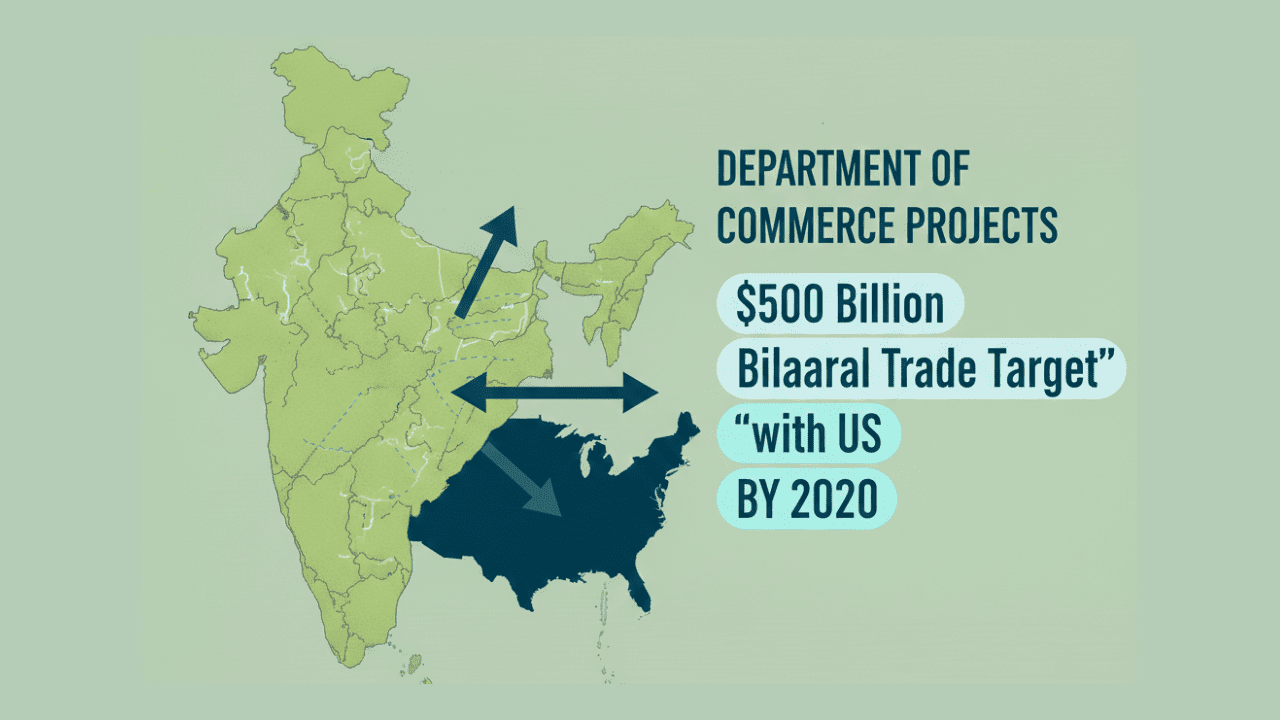
In a move that signals a historic strengthening of economic ties, the Department of Commerce has officially projected a bilateral trade target of $500 billion between India and the United States by 2030. This ambitious “Mission-500” framework, finalized in February 2026, aims to more than double the current trade volume, which stood at approximately $190 billion in 2023. Following a series of high-level dialogues between Prime Minister Narendra Modi and U.S. President Donald Trump, the two nations have committed to a “US-India Compact for the 21st Century.” This compact is designed to accelerate cooperation in commerce, technology, and military partnerships, positioning the India-US relationship as the “defining partnership” of the decade and a critical pillar for global economic stability.
The projection is backed by a newly finalized Interim Trade Agreement, which serves as the first phase of a broader, multi-sector Bilateral Trade Agreement (BTA). Union Commerce Minister Piyush Goyal described the $500 billion target as “extremely conservative” for an Indian economy aiming for $30 trillion by 2047. By aligning the “Make in India” initiative with the U.S. “Reciprocal Trade” philosophy, the Department of Commerce is creating a structured roadmap to dismantle long-standing trade barriers, integrate supply chains, and foster innovation across strategic high-growth sectors.
Mission-500: A Strategic Roadmap for Expansion
The roadmap to $500 billion is built on an integrated approach that covers both goods and services. The Department of Commerce has identified several “anchor sectors” that will provide the bulk of the trade volume growth over the next five years.
Key strategic pillars of Mission-500 include:
- The $500 Billion Purchase Intent: As a show of commitment, India has announced plans to procure $500 billion worth of U.S. goods and services over the next five to seven years. This include existing and upcoming orders for Boeing aircraft, aircraft engines, and specialized energy products.
- Energy Sovereignty Integration: A major shift toward U.S. energy sources, including crude oil, Liquefied Natural Gas (LNG), and coking coal, is expected to account for a significant portion of India’s import growth.
- High-Tech Corridor: Significant increases in trade for Graphics Processing Units (GPUs), AI hardware, and quantum computing machinery, with U.S. tech giants like Nvidia and AMD playing a central role in India’s AI Mission.
Sectoral Gains: Pharma, Aerospace, and Tech
The Department of Commerce has secured “negotiated outcomes” that protect India’s export strengths while opening up new markets for American providers.
- Pharmaceuticals: Indian generic drug makers and pharmaceutical ingredient manufacturers have gained improved access to the U.S. market. With India exporting nearly $9.8 billion worth of pharma products to the U.S. annually, the removal of specific regulatory hurdles is expected to drive double-digit growth in this sector.
- Aerospace and Defense: The framework includes duty-free access for certain Indian-made aircraft parts. This is a massive boost for the domestic aerospace industry, which is increasingly becoming a supplier to global majors like Boeing and GE.
- Electronics and Digital Trade: The agreement aims to address discriminatory or burdensome practices in digital trade, setting a clear pathway for robust, mutually beneficial rules. India’s push for 10 GW of data centers will be fueled by U.S.-sourced high-end technology and ICT products.
Addressing Non-Tariff Barriers and Regulatory Pain Points
A critical hurdle in reaching the $500 billion mark has been the presence of non-tariff barriers (NTBs) that delay market access and increase costs. Under the new framework, the Department of Commerce has agreed to a “reciprocal streamlining” of procedures.
India has committed to:
- Streamlining ICT Licensing: Eliminating restrictive import licensing procedures for Information and Communication Technology goods that previously caused logistical delays.
- Medical Device Access: Addressing regulatory “pain points” for U.S.-made medical equipment, ensuring that Indian hospitals have access to the latest diagnostic and surgical technology.
- Standards Harmonization: Discussing standards and conformity assessment procedures to ensure “Ease of Compliance” for exporters on both sides.
In return, the U.S. has reduced tariffs on a range of Indian goods—including textiles, leather, and organic chemicals—to a reciprocal 18%, down from the peak punitive rates of 50%.
The Role of Investment and Greenfield Projects
The $500 billion target is not just about the exchange of goods but about deep-rooted investment. The Department of Commerce is actively promoting Greenfield Investments in high-value industries. The U.S. remains India’s largest source of Foreign Direct Investment (FDI) in the tech sector, and the new agreement encourages further joint ventures in critical mineral processing and semiconductor fabrication.
The “US-India Compact” also envisions a 10-year framework for a Major Defence Partnership (2025–2035). This includes co-production agreements for land and air systems, which will contribute to the trade volume through the export of specialized components and services. By fostering an environment of “co-development and co-creation,” the two nations are ensuring that the economic partnership is resilient against third-party non-market policies.
Conclusion: A Historic Milestone in Global Trade
The Department of Commerce’s projection of a $500 billion trade target marks the beginning of a transformative chapter in India-US relations. By moving from a period of tariff tensions to a framework of “Reciprocal and Mutually Beneficial Trade,” both nations have set a global benchmark for economic diplomacy. This agreement ensures that the Indian manufacturing sector, the American technology sector, and the farmers of both nations are the primary beneficiaries of this growth.
As India continues its “Reform Express” and works toward the finalization of the full Bilateral Trade Agreement (BTA) by the fall of 2026, the $500 billion target serves as the North Star for the partnership. It is a shared resolution that will drive prosperity, security, and innovation, ensuring that the path to a Viksit Bharat in 2047 is powered by a robust and reliable global partnership.