
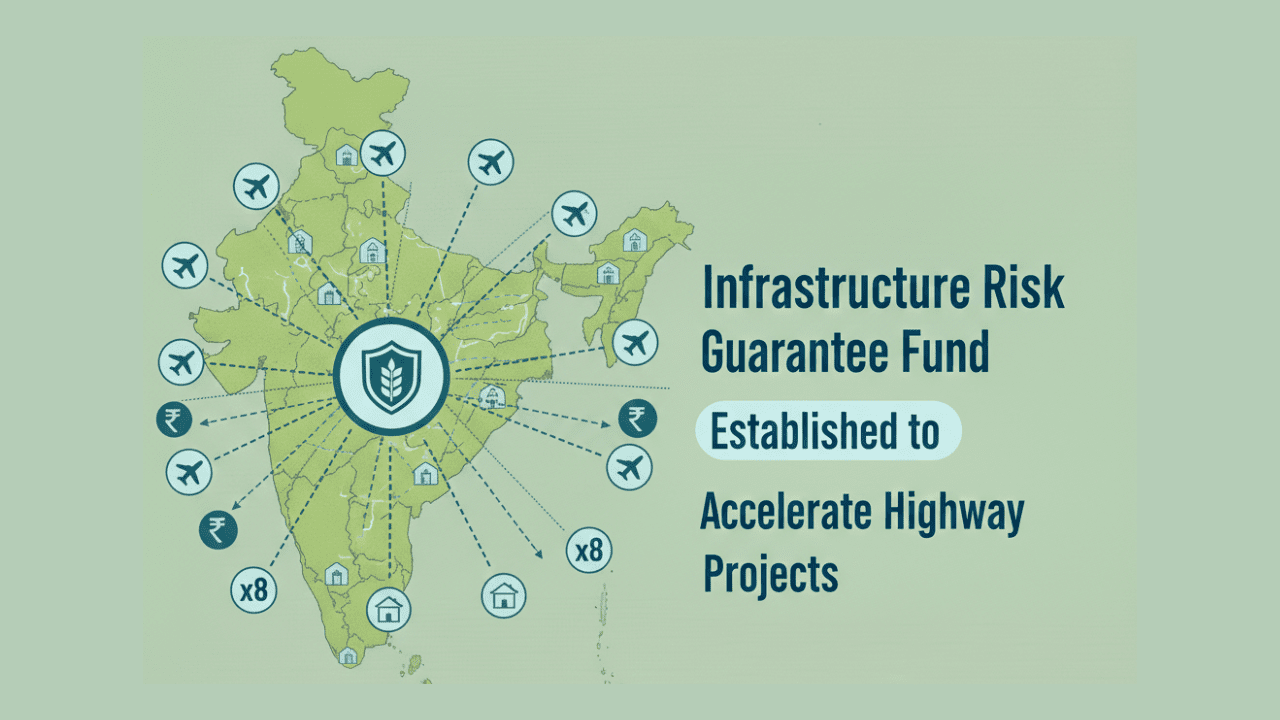
In a move designed to revitalize the Public-Private Partnership (PPP) model and remove financing bottlenecks in the infrastructure sector, the Government of India has officially established the Infrastructure Risk Guarantee Fund (IRGF). Announced as a major structural reform in the Union Budget 2026-27, the fund is specifically aimed at de-risking large-scale National Highway projects during their most vulnerable stages. By providing prudently calibrated partial credit guarantees to lenders, the government is addressing the long-standing hesitation of banks and institutional investors to fund projects with long gestation periods and high construction-phase risks. This initiative is expected to act as a force multiplier for the National Highways Authority of India (NHAI), which has been allocated ₹1.87 lakh crore for the 2026-27 fiscal year to maintain its aggressive expansion targets.+3
The creation of the IRGF marks a departure from traditional subsidy-heavy models toward a sophisticated risk-sharing mechanism. The Finance Ministry noted that while India’s highway network has expanded rapidly, the “private capital engine” had slowed due to concerns over cost overruns, regulatory delays, and cash-flow mismatches. The new fund serves as a “first-loss” guarantee, effectively improving the credit rating of individual projects and allowing developers to access cheaper, long-term capital from pension funds and insurance companies.+2
Addressing Construction-Phase Vulnerabilities
Infrastructure projects are at their highest risk profile before they become operational and begin generating toll revenue. The IRGF is strategically focused on this “pre-commissioning” window.
Key operational features of the fund include:
- Partial Credit Guarantees: The fund does not offer a blanket bailout but covers a specified percentage of the loan (typically 20-30%) in the event of a default during the construction or early operational phase.
- Targeted De-risking: It specifically covers “non-commercial” and “policy-related” risks, such as unexpected land acquisition delays or shifts in regulatory frameworks, which are often beyond the developer’s control.
- Refinancing Catalyst: By providing a guarantee during the risky initial years, the fund makes it easier for projects to be “refinanced” through the corporate bond market once they reach the stable operational stage.
Impact on NHAI and the National Highway Pipeline
The IRGF is a timely intervention for the National Highways Authority of India, which is currently managing a massive pipeline of 124 highway projects totaling over 6,300 km. With the government’s target to increase the pace of construction to 60 km per day, the need for private liquidity is paramount.
The fund is expected to have a direct positive impact on several fronts:
- Accelerating BoT (Build-Operate-Transfer) Projects: The government aims to move back toward the BoT (Toll) model to reduce the direct fiscal burden on the exchequer. The IRGF provides the “confidence bridge” required for private developers to take on the traffic risk associated with BoT projects.+1
- Debt Sustainability: For entities like the National Highways Infra Trust (NHIT), the fund helps secure debt at more favorable interest rates, improving their debt-servicing capacity and allowing them to acquire more completed assets from NHAI.
- Reducing Stalled Projects: By providing a safety net for lenders, the fund prevents viable projects from being abandoned midway due to temporary liquidity crunches, ensuring that national assets are completed on schedule.
Unlocking Institutional and Global Capital
A developed infrastructure sector requires a deep pool of capital that banks alone cannot provide. The IRGF is designed to “crowd-in” institutional investors who have traditionally avoided the construction phase due to strict risk-rating mandates.+1
With the government’s guarantee in place, highway projects can achieve the ‘AA’ or higher rating required by domestic insurance and pension funds to invest. This unlocks trillions of rupees in long-term domestic savings for nation-building. Furthermore, the fund is a signal to global sovereign wealth funds that India is committed to a stable and predictable investment climate. Finance Ministry officials have indicated that the fund will operate with a high degree of transparency, using digital audit trails to monitor project progress and guarantee triggers.
Integration with the ‘Three Kartavyas’ and Gati Shakti
The Infrastructure Risk Guarantee Fund is a vital component of the first Kartavya (Duty to Growth) and the PM Gati Shakti National Master Plan. By ensuring that highway projects are not stalled by financing issues, the government is fulfilling its duty to build a seamless, world-class logistics backbone for the country.
The 2026-27 Budget has proposed an overall public capital expenditure of ₹12.2 lakh crore, and the IRGF is the tool that ensures this public money is supplemented by an even larger pool of private investment. Whether it is connecting mineral-rich areas of Odisha to major ports or expanding the high-speed corridors in Tamil Nadu, the fund ensures that the “financial plumbing” of these projects is as robust as the physical asphalt.
Conclusion: A New Era of Professionalized Infrastructure Finance
The establishment of the Infrastructure Risk Guarantee Fund represents the professionalization of infrastructure finance in India. It acknowledges that the state’s role is not just to build, but to create a stable environment where the private sector can thrive. By taking on the tail-end risks that keep lenders awake at night, the government has cleared the path for a massive surge in highway development.
As the implementation guidelines are finalized in the coming months, the IRGF will become the cornerstone of India’s PPP 2.0 strategy. For the Indian citizen, this means faster travel, lower logistics costs, and better-connected cities. For the Indian economy, it means a more resilient and predictable path toward the goal of a $30 trillion Viksit Bharat by 2047. The “Infrastructure Safety Net” is now in place, and the Reform Express is set to reach its next milestone with unprecedented speed and confidence.