
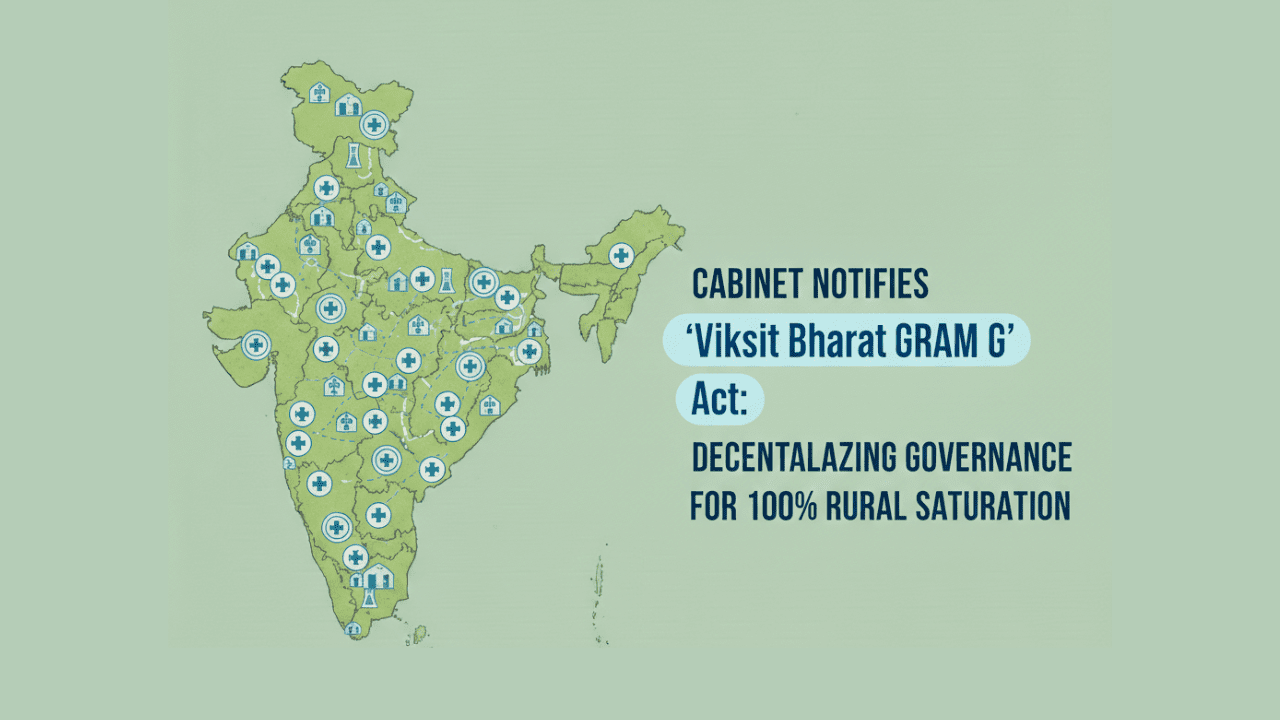
NEW DELHI – In a move that fundamentally redefines rural social security and administrative architecture, the Union Cabinet has officially notified the Viksit Bharat—Guarantee for Rozgar and Ajeevika Mission (Gramin) (VB—G RAM G) Act, 2025. This landmark legislation, which received presidential assent in late December 2025, effectively replaces the Mahatma Gandhi National Rural Employment Guarantee Act (MGNREGA) of 2005. The notification marks the beginning of a phased rollout designed to achieve “100% Rural Saturation,” moving India from a rights-based welfare model to a “duty-based” infrastructure and livelihood mission. By decentralizing planning power directly to the Gram Sabhas, the Act ensures that every rural household is not only a beneficiary of employment but a stakeholder in the creation of national assets.
The Union Budget 2026-27 has underscored this commitment with a massive allocation of ₹95,600 crore for the new Mission. Unlike its predecessor, the VB—G RAM G Act is anchored in the “Saturation Principle,” aiming to ensure that no eligible rural household is left without a productive livelihood. The Prime Minister has described the Act as the “Constitutional bedrock for Rural Prosperity,” emphasizing that the decentralization of financial and planning autonomy is the only way to reach the last mile of Viksit Bharat by 2047.
An Enhanced Statutory Guarantee: 125 Days of Work
The most visible change in the new Act is the enhancement of the statutory employment guarantee. While the 2005 Act provided for 100 days of work, the VB—G RAM G Act mandates not less than 125 days of wage employment per rural household in each financial year.
This 25% increase is designed to provide greater income predictability for the agrarian workforce. To balance this with agricultural needs, the Act introduces a “Notified Harvest Pause”—a cumulative 60-day window during peak sowing and harvesting seasons when public works are suspended. This ensures that farmers have adequate labor availability while workers are guaranteed their full 125-day entitlement during the remaining 305 days of the year.
The Four Vertical Strategy for Asset Creation
To move away from “scattered works” with limited long-term value, the new Act integrates employment with a strategic National Rural Infrastructure Stack. All works must now fall under four clearly defined priority verticals:
- Water Security: Focused on rejuvenation of traditional water bodies, groundwater recharge, and micro-irrigation infrastructure to support sustainable agriculture.
- Core Rural Infrastructure: Building high-quality, weather-resilient village roads, Panchayat Bhavans, and multi-purpose community centers.
- Livelihood-Related Infrastructure: Creating durable assets such as SHE-Marts (Women’s Self-Help Group retail outlets), specialized storage godowns, and cold-chain collection centers.
- Extreme Weather Mitigation: Special works dedicated to disaster preparedness, including cyclone shelters, drainage systems for flood-prone areas, and afforestation to combat heatwaves.
Decentralization through ‘Viksit Gram Panchayat Plans’
The Act marks the most significant transfer of planning authority since the 73rd Amendment. The concept of the “Labour Budget” has been replaced by the Viksit Gram Panchayat Plan (VGPP).
Under this decentralized model:
- Bottom-Up Planning: The Gram Sabha is the final authority for identifying and prioritizing projects based on local spatial needs.
- PM Gati Shakti Integration: These local plans are digitally integrated into the PM Gati Shakti National Master Plan, ensuring that village-level infrastructure aligns with national logistics and industrial corridors.
- Spatial Auditing: Worksites are monitored in real-time through biometric authentication and GPS-based geo-tagging, ensuring that “ghost assets” and attendance fraud are eliminated through technology.
A Revised Financial Architecture: Cooperative Federalism
The VB—G RAM G Act introduces a new 60:40 cost-sharing ratio between the Centre and the States for most regions, representing a shift toward shared fiscal responsibility. However, to protect the interests of geographically challenged regions, the 90:10 ratio is maintained for North-Eastern states, Himalayan states (including Uttarakhand and Himachal Pradesh), and the Union Territory of Jammu & Kashmir.
To ensure that administrative hurdles do not impede delivery, the administrative expenditure ceiling has been raised from 6% to 9%. This additional 3% is specifically earmarked for enhancing technical staffing, training Gram Rozgar Sahayaks, and strengthening the digital infrastructure required for real-time reporting.
Conclusion: From Welfare to Empowerment
The notification of the ‘Viksit Bharat G RAM G’ Act is a defining moment for rural India. By providing an enhanced 125-day guarantee and empowering Panchayats with genuine planning autonomy, the government is treating the rural workforce as an active partner in India’s industrial and infrastructure story. This “Whole-of-Government” approach ensures that every rupee spent on rural employment also contributes to a durable national asset.
As the implementation begins, the Act will serve as a catalyst for reversing rural-to-urban distress migration and building a self-reliant rural economy. The path to a $30 trillion Viksit Bharat is now firmly rooted in the empowerment of the Gram Panchayat, ensuring that the fruits of development are saturated across every village in the country by 2047. The “Reform Express” has reached the village square, and its cargo is prosperity, dignity, and a permanent roof for every dream.