
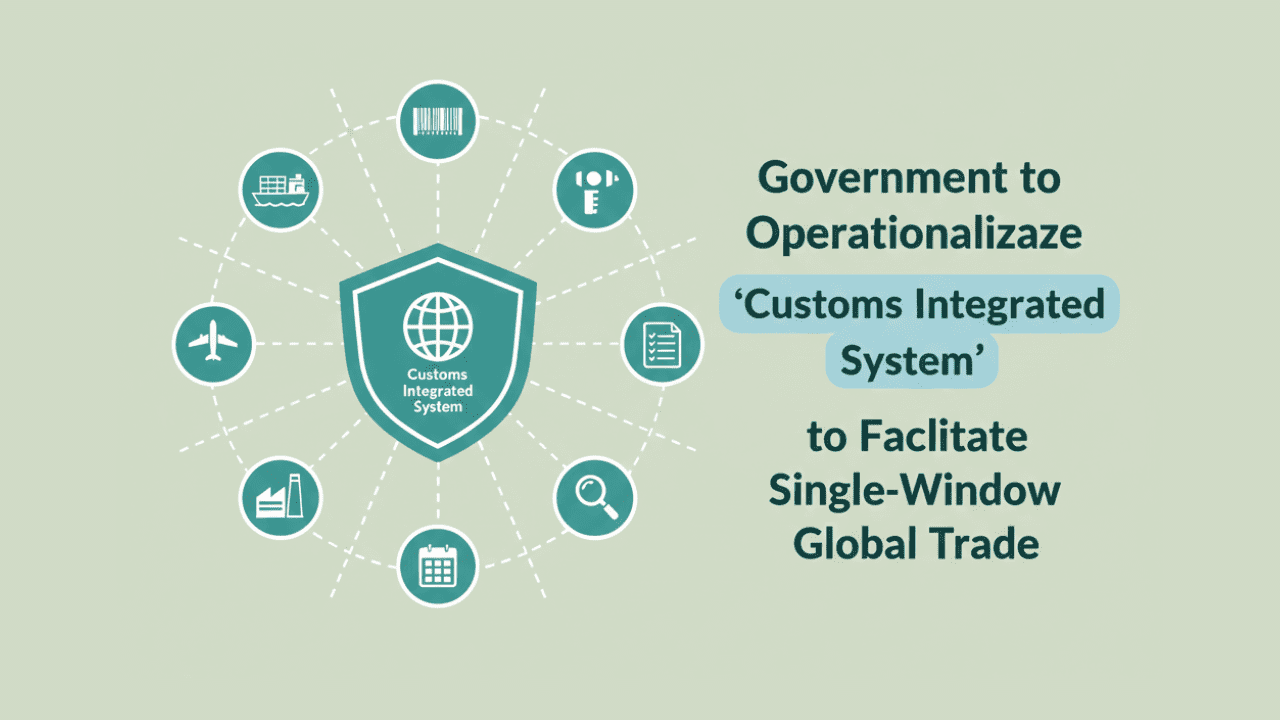
To reduce the dwell time of cargo and modernize India’s entry and exit points, the Union Ministry of Finance has announced the phased rollout of the Customs Integrated System (CIS). Unveiled by Finance Minister Nirmala Sitharaman during the Union Budget 2026-27, the CIS is envisioned as a single, scalable, and high-tech digital platform that will consolidate all customs processes—from filing and risk assessment to clearance and payment. The system is set to be fully operational within the next two years, replacing the fragmented legacy systems like ICEGATE and ICES with a unified interface. This reform is a cornerstone of the ‘Reform Express’ mission, aiming to transform India into a global trading hub by reducing the average clearance time for imports from two days to less than 24 hours.
The CIS is more than just a software upgrade; it represents a fundamental shift toward “Trust-Based Customs.” By leveraging AI and advanced imaging, the government intends to shift from physical inspections to non-intrusive, risk-based audits. The ultimate goal, as highlighted in the budget, is to achieve 100% non-intrusive scanning for all containers at major ports, ensuring national security while facilitating the seamless flow of legitimate trade.
The Unified Digital Window: Interconnecting Agencies
A major pain point for Indian traders has been the need for multiple approvals from various Partner Government Agencies (PGAs). The CIS addresses this by creating a Single, Interconnected Digital Window.
By April 2026, the government plans to operationalize the clearance processes for food, drugs, plant, animal, and wildlife products on this new system. These sectors alone account for roughly 70% of interdicted cargo. Under the new framework:
- Seamless NOCs: Approvals from agencies like FSSAI, CDSCO, and AQCS will be processed through the central CIS portal, eliminating the need for exporters and importers to visit individual agency sites.
- Automatic Clearance: For “Trusted Importers” with no compliance requirements, the system will grant automatic clearance immediately after online registration and duty payment, with no manual intervention required.
- Consolidated Assessments: Tax and penalty proceedings will now be handled through a single, consolidated order, reducing the administrative burden on businesses.
Automation and AI: The End of ‘Physical Interface’
The Customs Integrated System marks the arrival of Faceless Customs 2.0. By removing the physical interface between tax officers and traders, the government is ensuring a transparent, objective, and corruption-free environment.
Key technological features include:
- AI-Risk Management System (RMS): The system uses machine learning to analyze global shipping patterns and identify “high-risk” cargo, allowing for 80-90% of cargo to pass through the ‘Green Channel’ without physical checks.
- Advanced Imaging: High-speed scanners integrated with the CIS will provide high-resolution images of container contents, which are then analyzed by AI for anomalies.
- Auto Let Export Order (LEO): For facilitated shipping bills meeting specific risk criteria, the system will automatically issue a “Let Export Order,” allowing goods to move directly from the factory gate to the ship.
Empowering E-commerce and Small Businesses
Recognizing the rise of digital trade, the CIS has been designed to support small-scale exporters and artisans. A major policy change announced alongside the system’s rollout is the complete removal of the ₹10 lakh value cap on courier exports.
This change, integrated with the CIS, allows MSMEs to export high-value items—such as high-end jewelry, specialized machinery, or premium handicrafts—through courier mode with the same ease as small consignments. The system will also feature a simplified module for handling returns and rejected consignments, a major hurdle for e-commerce sellers, by using automated risk checks to verify the identity of returned goods.
Boosting Marine Exports and Fisheries
The CIS also introduces specialized modules for the blue economy. In a significant relief for the fishing community, the government has notified that fish catch by Indian vessels in the Exclusive Economic Zone (EEZ) or on the High Seas will now be free of duty.
Through the CIS portal:
- Simplified Landing: Indian vessels can land their catch at foreign ports, which will be treated as an “export of goods” with automated documentation.
- Safeguard Mechanisms: The system will use satellite tracking and digital logs to prevent the misuse of duty-free benefits during transit and transshipment.
Conclusion: A ‘Wharf to Warehouse’ Revolution
The operationalization of the Customs Integrated System is a decisive step toward making India “Trade-Ready” for the $30 trillion goal of 2047. By combining all customs-related activities into a single, scalable, and AI-driven platform, the government is providing the “Ease of Doing Business” that global value chains demand. This reform reduces transaction costs, minimizes human error, and ensures that the Indian port is no longer a bottleneck but a gateway.
As the system matures over the next 24 months, it will serve as the digital backbone of India’s economic diplomacy. From the “factory gate to the ship’s rail,” the CIS ensures that the “Reform Express” carries Indian products to the global market with unprecedented speed and transparency. For the Indian entrepreneur, the message is clear: the borders are open, the rules are simple, and the system is on your side.