
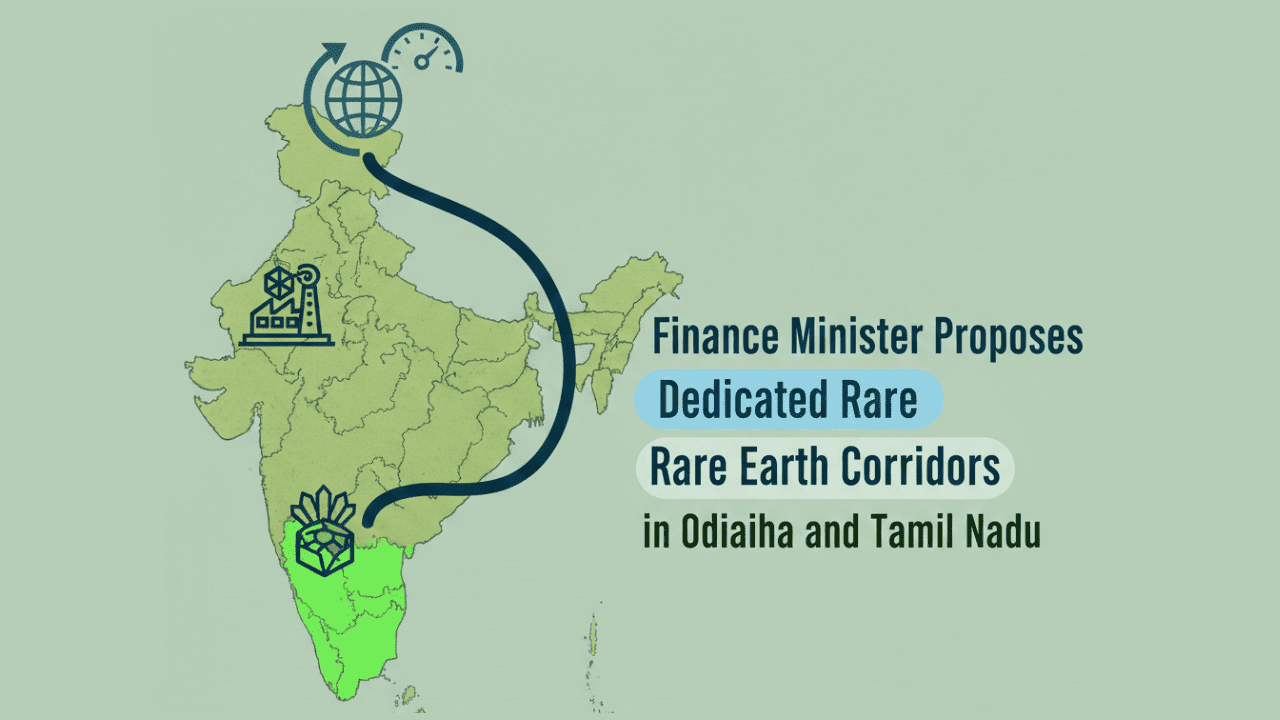
In a strategic move to secure India’s technological sovereignty and de-risk global supply chains, Finance Minister Nirmala Sitharaman has proposed the establishment of dedicated Rare Earth Corridors in the coastal states of Odisha and Tamil Nadu. Announced as a flagship initiative under the Union Budget 2026-27, these corridors are designed to transform India from a net importer of critical minerals into a global processing hub. By creating integrated zones for extraction, refining, and value addition, the government aims to provide the foundational materials required for the “Twin Transitions” of green energy and digital transformation. This proposal marks a significant shift in India’s industrial policy, moving toward a “Critical Mineral Security” framework that underpins the India Semiconductor Mission (ISM) 2.0 and the nation’s electric vehicle (EV) ambitions.
Rare Earth Elements (REEs) are the unsung heroes of the modern economy, essential for everything from permanent magnets in EV motors and wind turbines to advanced semiconductors and defense electronics. Despite possessing the world’s fifth-largest reserves of monazite sands—the primary source of rare earths—India has historically underutilized these resources due to technological bottlenecks and fragmented processing capabilities. The proposed corridors in Odisha and Tamil Nadu are intended to solve this by co-locating state-of-the-art refineries with downstream manufacturing units, ensuring that the entire value chain remains within the country’s borders.
The Strategic Geography: Why Odisha and Tamil Nadu?
The selection of Odisha and Tamil Nadu for these dedicated corridors is based on their unique geological and logistical advantages. Both states possess extensive coastlines rich in heavy mineral sands, managed primarily by IREL (India) Limited.
In Odisha, the corridor will focus on the Ganjam district, leveraging the existing expertise at the Rare Earths Division and the deep-water capabilities of the Gopalpur port. The Odisha corridor is envisioned as a “Heavy REE” hub, concentrating on elements like Dysprosium and Terbium, which are critical for high-temperature magnets used in aerospace and defense.
In Tamil Nadu, the corridor will be centered around the Kanyakumari and Thoothukudi belt. This region is strategically positioned to serve the massive “Electric Vehicle Valley” in Western Tamil Nadu. By refining Neodymium and Praseodymium locally, the corridor will provide a direct, low-cost supply of raw materials to the motor and battery manufacturers in the state, significantly reducing the logistics cost and lead times that currently plague the industry.
Infrastructure and Technology: The ‘Critical Mineral Mission’
The Finance Minister notified that the Rare Earth Corridors will be governed under a new Critical Mineral Mission, which has been allocated an initial seed fund of ₹2,500 crore. This mission is tasked with more than just mining; it is about “Technological Leapfrogging.”
Key components of the corridor infrastructure include:
- Common User Facilities (CUFs): The government will set up shared refining and separation plants that can be utilized by both public and private sector players. This reduces the high entry barrier for private startups in the rare earth space.
- Specialized Effluent Treatment Plants (ETPs): Recognizing the environmental sensitivity of rare earth processing, the corridors will feature world-class waste management systems to ensure “Zero Liquid Discharge” and safe handling of radioactive by-products like thorium.
- R&D Centers of Excellence: In collaboration with the Bhabha Atomic Research Centre (BARC) and CSIR-IMMT, the corridors will host research labs dedicated to developing indigenous, eco-friendly solvent extraction technologies.
De-risking the Supply Chain: From Import to Export
Currently, the global rare earth market is highly concentrated, with a single country controlling over 90% of the processing capacity. This creates a “single point of failure” for India’s high-tech industries. The proposed corridors are a proactive measure to build a China-plus-one supply chain.
By processing REEs domestically, India can protect its manufacturers from global price volatility and export bans. Furthermore, the corridors are designed with an “Export-Oriented” mindset. The Finance Minister emphasized that India aims to become a reliable supplier of refined rare earth oxides to strategic partners like the US, Japan, and the European Union. This aligns with the Mineral Security Partnership (MSP), a global coalition that India joined to ensure stable mineral supplies for the clean energy transition.
Incentives and Private Sector Participation
To attract global expertise and domestic investment, the government has introduced a “Phased Manufacturing Program” for rare earth magnets and catalysts. Private companies setting up units within these corridors will be eligible for:
- Production Linked Incentives (PLI): Extensions of the PLI scheme for advanced chemistry cells and electronics to include rare earth components.
- Tax Holidays: Targeted corporate tax breaks for the first ten years of operation for companies achieving high purity levels in REE separation.
- Customs Duty Waivers: Exemption of duties on specialized machinery and equipment required for deep-sea mining and molecular-level separation.
The government has also indicated a willingness to review the Mines and Minerals (Development and Regulation) Act to allow deeper private sector participation in the extraction of certain “deep-seated” critical minerals, which were previously reserved for the state.
Conclusion: Fueling the Future of Viksit Bharat
The proposal for dedicated Rare Earth Corridors in Odisha and Tamil Nadu is a bold declaration that India is ready to play a leading role in the Fourth Industrial Revolution. These corridors are the “silent engines” that will power the electric cars, smart devices, and green energy grids of tomorrow. By securing the materials of the future, the government is not just building industries; it is building national resilience.
As the “Reform Express” carries this mission forward, the success of these corridors will be a critical benchmark for the goal of a $30 trillion economy by 2047. Through the ‘Three Kartavyas’—duty to growth, duty to technology, and duty to the environment—the Rare Earth Corridors will ensure that India’s growth is powered by its own soil and its own brilliance. The “Sovereign Magnet” is now being forged in the sands of Odisha and Tamil Nadu, promising a more secure and prosperous future for every Indian.