
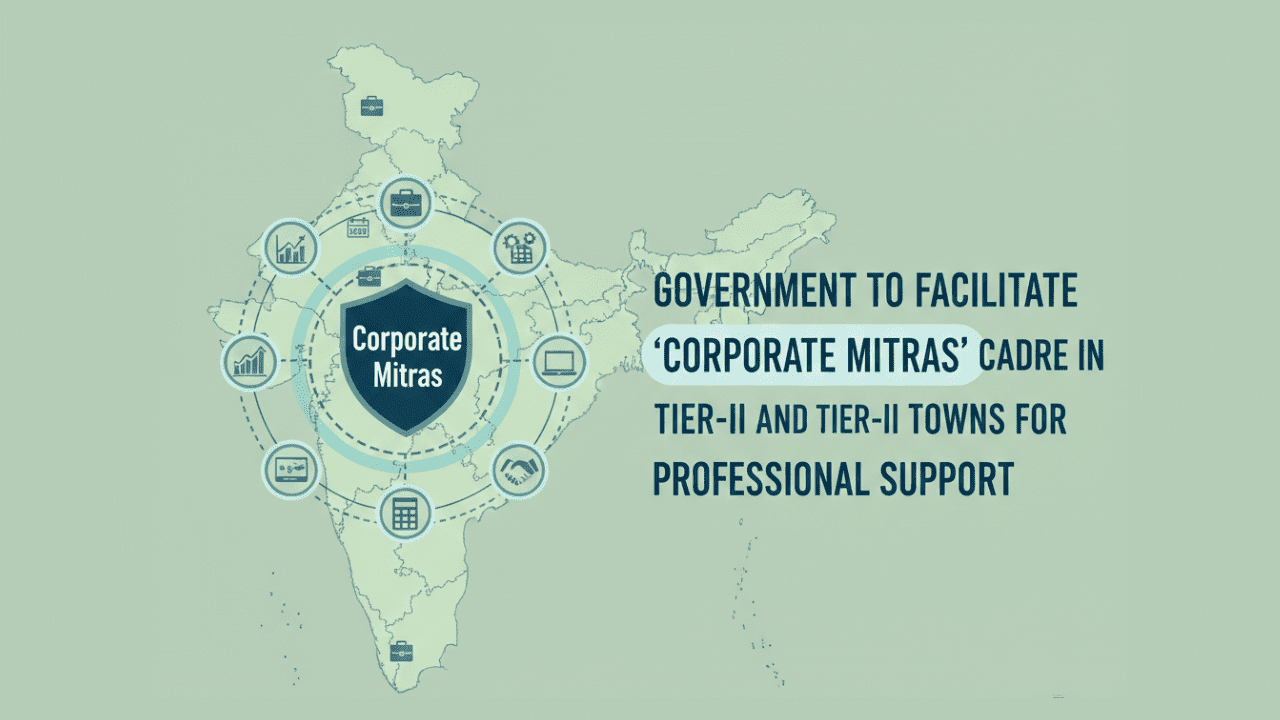
In a pioneering effort to democratize professional services and ease the regulatory burden on small businesses, the Government of India has announced the creation of a specialized cadre of ‘Corporate Mitras’. Unveiled by Finance Minister Nirmala Sitharaman during the Union Budget 2026-27, this initiative is specifically designed to provide affordable, on-ground professional support to Micro, Small, and Medium Enterprises (MSMEs) operating in Tier-II and Tier-III towns. By developing a national pool of accredited para-professionals, the government aims to bridge the “compliance gap” that often prevents small-scale entrepreneurs in non-metropolitan areas from scaling their operations or accessing formal credit.
The ‘Corporate Mitras’ initiative represents a strategic shift from traditional, often expensive consultancy models toward a decentralized, community-based support system. For many first-generation entrepreneurs in smaller cities, the complexity of statutory filings and the high cost of professional fees act as significant deterrents to formalization. Through this new cadre, the Ministry of Corporate Affairs (MCA) and the Ministry of Finance are working to ensure that “Ease of Doing Business” is not just a slogan for large corporations but a practical reality for every small unit in the country.
Defining the Corporate Mitras: Accredited Para-Professionals
A Corporate Mitra is envisioned as an accredited para-professional—a trained facilitator who acts as a bridge between the small business owner and the complex regulatory machinery of the state. These individuals are not intended to replace Chartered Accountants (CAs) or Company Secretaries (CSs) for high-end advisory but are meant to handle the volume of routine, essential compliance tasks that often overwhelm small businesses.
The government has partnered with three premier professional institutions to design the curriculum and certification for this cadre:
- The Institute of Chartered Accountants of India (ICAI)
- The Institute of Company Secretaries of India (ICSI)
- The Institute of Cost Accountants of India (ICMAI)
These institutions will facilitate short-term, modular courses and provide practical tools to train local youth and professionals in Tier-II and Tier-III towns. The training will focus on hands-on skills such as GST reconciliation, basic bookkeeping, Udyam registration, and statutory labor law filings. Once certified, these “Mitras” (friends) will be authorized to provide low-cost services, ensuring that the MSMEs have a reliable, local point of contact for their day-to-day administrative needs.
Core Objectives: Compliance, Credit, and Competitiveness
The rollout of the Corporate Mitras cadre is part of a “three-pronged approach” to strengthen the MSME ecosystem, focusing on liquidity, equity, and professional support. The government has identified that a lacks of proper documentation is the single largest hurdle for MSMEs when seeking bank loans. By helping businesses maintain clean financial records, Corporate Mitras will directly improve the creditworthiness of the sector.
The key services to be provided by Corporate Mitras include:
- Statutory Compliance: Assisting with the timely filing of GST returns, Income Tax returns, and annual ROC (Registrar of Companies) filings for small companies.
- Bookkeeping & Documentation: Helping micro-units move from informal ledger-keeping to digital accounting, which is essential for transparent cash-flow analysis.
- Accessing Schemes: Guiding entrepreneurs through the application processes for government incentives like the SME Growth Fund, Self-Reliant India Fund, and the TReDS (Trade Receivables Discounting System) platform.
- Formalization: Facilitating the transition of unregistered units into the formal economy through Udyam and other necessary local body registrations.
Decentralizing Professional Services in Smaller Towns
The geographic focus on Tier-II and Tier-III towns is a deliberate move to decentralize India’s professional service industry. Currently, most high-quality consultancy firms are concentrated in Tier-I cities like Mumbai, Delhi, and Bengaluru. This creates a “service vacuum” in emerging industrial hubs like Coimbatore, Indore, Jaipur, or Ludhiana, where MSMEs either have to pay a premium for outstation experts or rely on unverified middlemen.
By creating a local cadre of Corporate Mitras, the government is fostering a “Grassroots Professionalism.” This not only lowers the cost of compliance for the business owner by 30-50% but also generates high-value employment opportunities for thousands of educated youth within their home districts. These professionals will be equipped with “Practical Toolkits”—software and digital templates provided by the professional institutes—allowing them to offer standardized, high-quality services regardless of their location.
Integration with the ‘Education to Employment and Enterprise’ Standing Committee
The Corporate Mitras initiative is closely aligned with another major budget announcement: the setting up of the ‘Education to Employment and Enterprise’ (E3) Standing Committee. This high-powered committee is tasked with recommending measures to make the services sector a core driver of Viksit Bharat. Corporate Mitras are seen as the “ground-level executors” of this E3 philosophy—converting specialized education into meaningful employment and, ultimately, supporting the growth of successful enterprises.
As part of the first Kartavya (Duty) of the government—to accelerate economic growth—the Corporate Mitras will also play a role in promoting the use of TReDS as a mandatory transaction settlement platform for all purchases from MSMEs by Central Public Sector Enterprises (CPSEs). By educating local vendors on how to discount their invoices on TReDS, these para-professionals will help solve the perennial problem of delayed payments, ensuring that liquidity remains available to the smallest players in the supply chain.
Conclusion: Strengthening the Backbone of India
The facilitation of the ‘Corporate Mitras’ cadre marks a landmark moment in India’s industrial policy. It recognizes that for an MSME to become a “Champion,” it needs more than just capital; it needs a supportive environment that simplifies the “business of doing business.” By empowering local professionals to assist local entrepreneurs, the government is creating a self-sustaining loop of growth and compliance.
As India moves toward its goal of becoming a $30 trillion economy by 2047, the millions of MSMEs in Tier-II and Tier-III towns will be the primary engines of this expansion. The Corporate Mitras will be their constant companions on this journey, ensuring that no business is left behind due to the complexities of paperwork. Through this initiative, the government is truly fulfilling its commitment to Sabka Saath, Sabka Vikas, building a resilient, transparent, and globally competitive India from the bottom up.