
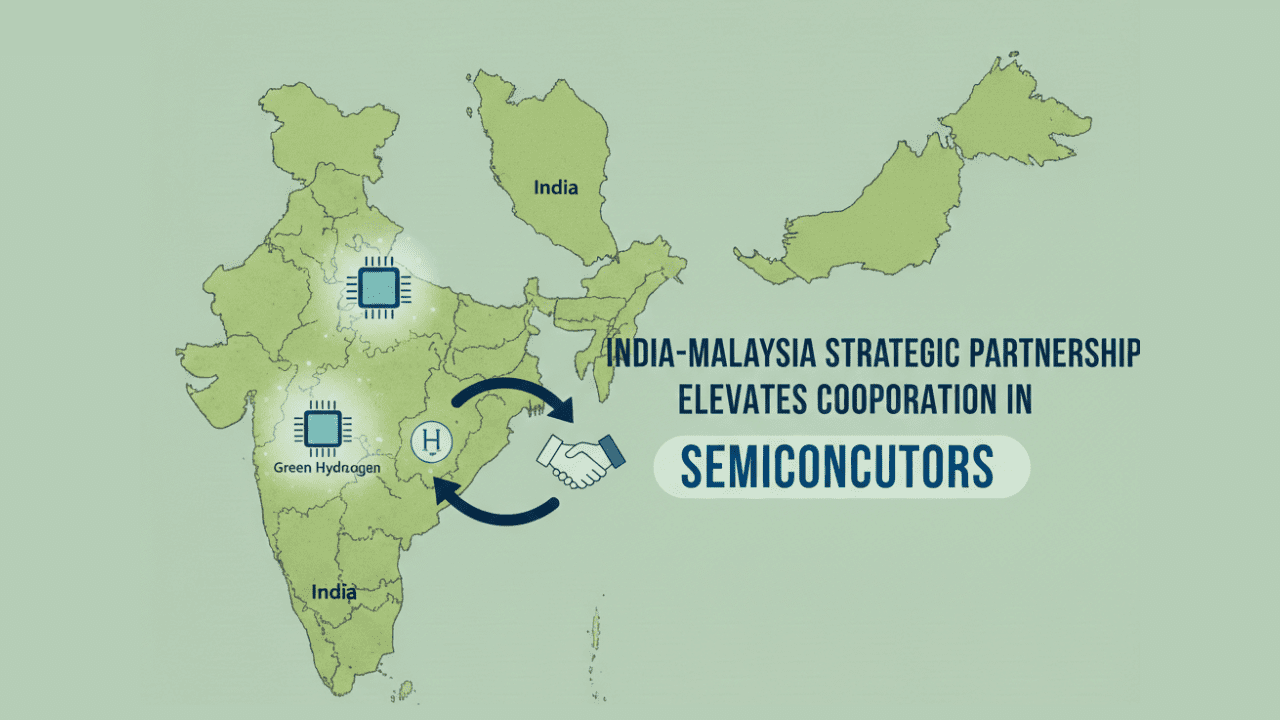
KUALA LUMPUR / NEW DELHI – Following Prime Minister Narendra Modi’s high-stakes two-day visit to Malaysia (February 7–8, 2026), India and Malaysia have officially escalated their Comprehensive Strategic Partnership with a specific focus on “Silicon and Sustainability.” The visit resulted in the signing of 11 landmark Memorandum of Understandings (MoUs), centering on semiconductors and green hydrogen as the twin pillars of a new era of technology-led growth. This strategic pivot aims to integrate India’s massive design and market scale with Malaysia’s mature manufacturing ecosystem, creating a resilient supply chain that can withstand global geopolitical shocks.
The partnership is anchored in the Malaysia-India Digital Council (MIDC), a new platform designed to synchronize the digital transformation agendas of both nations. By focusing on critical future technologies, the two countries are moving beyond traditional trade in petroleum and palm oil toward a high-value relationship that prioritizes deep-tech innovation and energy security.
The Semiconductor Corridor: From Design to Fabrication
Malaysia currently accounts for roughly 13% of the global semiconductor assembly, testing, and packaging (ATP) market and is the world’s sixth-largest exporter. India, under its ISM 2.0 (India Semiconductor Mission), is aggressively seeking partners to build a domestic ecosystem.
Key Initiatives in the Semiconductor Vertical:
- G2G Framework Agreement: A multi-layered collaboration pact was signed to integrate India’s IC design capabilities with Malaysia’s established fabrication and packaging hubs in Penang and Kuala Lumpur.
- Industry-Led Linkages: The Indian Electronics and Semiconductor Association (IESA) and the Malaysia Semiconductor Industry Association (MSIA) have officially linked their networks to stabilize supply chains and facilitate joint R&D.
- Workforce Development: A landmark collaboration has been established between IIT-Madras Global and the Advanced Semiconductor Academy of Malaysia (ASEM) to build a “future-ready” workforce of specialized engineers.
- Investment Interests: Major Indian firms, including Tata Electronics, are in advanced talks to acquire or establish outsourced semiconductor assembly and test (OSAT) plants in Malaysia.
Green Hydrogen and the Net-Zero Synergy
The energy partnership has seen a major push toward clean fuels, with Malaysia’s state-owned energy giant PETRONAS and its green energy arm Gentari taking a leading role in India’s renewable landscape.
Highlights of the Energy Partnership:
- Large-Scale Green Hydrogen Hubs: Prime Minister Modi and PM Anwar Ibrahim recognized the progress of PETRONAS and Gentari in developing green hydrogen and green ammonia projects in India. These projects are critical for decarbonizing India’s heavy industries.
- Solar Collaboration: Leveraging Malaysia’s expertise in large-scale solar initiatives, both nations agreed to collaborate on massive solar parks and distributed energy solutions.
- International Solar Alliance (ISA): Malaysia reaffirmed its support for the India-led ISA, acknowledging it as a vital platform for global clean energy transition.
- Local Currency Trade Settlement: In a move to reduce dependency on the US Dollar and lower transaction costs for energy and tech imports, the RBI and Bank Negara Malaysia are operationalizing trade settlement in Indian Rupees (INR) and Malaysian Ringgit (MYR).
Defence and Digital Payments: The Strategic Orbit
The relationship has also evolved into a sophisticated operational partnership in defence and digital finance, providing a secure foundation for the tech and energy initiatives.
- Su-30 Forum: Both nations operate Russian-origin Sukhoi Su-30 fighter jets. A newly formed forum enables the Indian Air Force (IAF) and the Royal Malaysian Air Force (RMAF) to share technical expertise, maintenance protocols, and spare parts, effectively bypassing supply chain hurdles.
- UPI-PayNet Linkage: India’s NPCI International (NIPL) and Malaysia’s PayNet are establishing a bilateral payment linkage. This will provide seamless, low-cost cross-border payment solutions for tourists, students, and small businesses.
- Maritime Security: The leaders resolved to strengthen cooperation in counter-terrorism and maritime security, particularly in the strategic corridors of the Indo-Pacific.
Conclusion: A Trusted Partnership for the Indo-Pacific
The 2026 India-Malaysia strategic update signifies a major shift toward “Strategic Trust” and technological interdependence. By combining their strengths in the high-stakes worlds of silicon and green energy, the two nations are positioning themselves as central growth engines for the global economy. As Prime Minister Modi noted during the CEO Forum, “The Indo-Pacific is the world’s growth engine, and the growing friendship between India and Malaysia is vital for the region’s stability and prosperity.”
This partnership ensures that as India moves toward its $30 trillion goal by 2047, it has a reliable, high-tech partner in Southeast Asia. The “Silicon-Hydrogen” bond is set to define the next decade of India-Malaysia relations, fostering a sustainable and resilient future for both nations.