
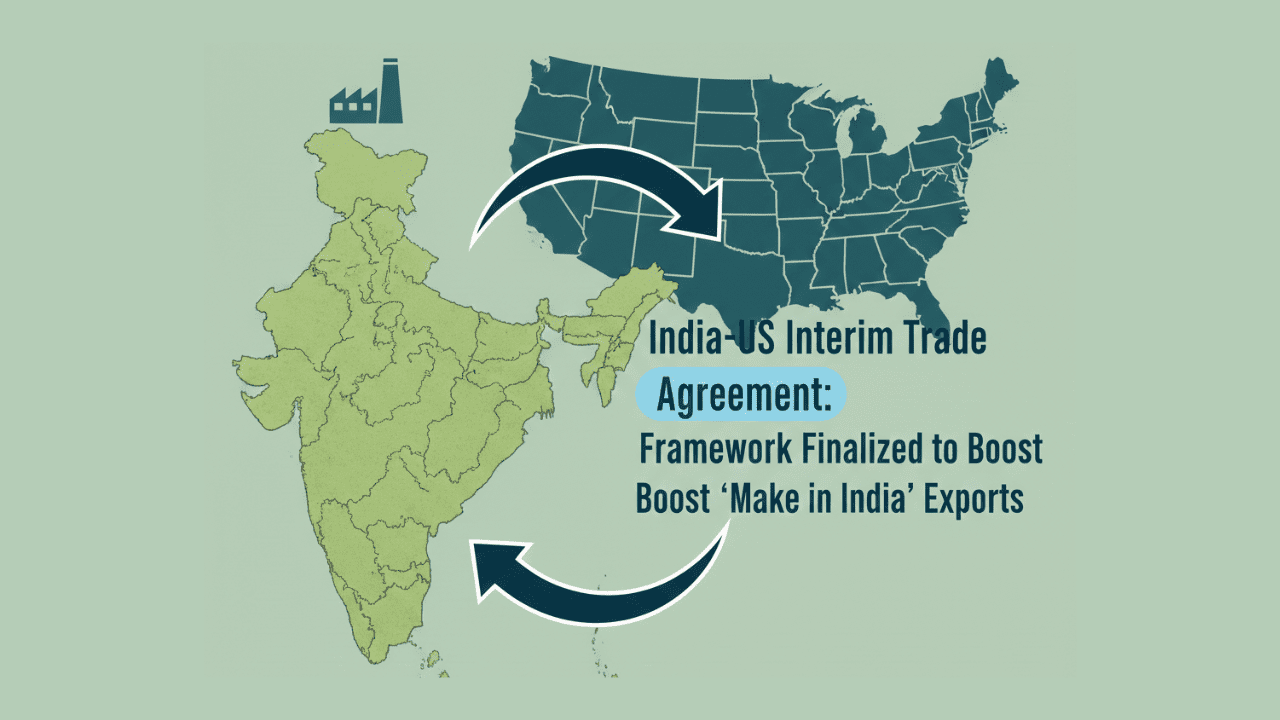
In a move that marks a strategic reset in bilateral relations, India and the United States have officially finalized the framework for an Interim Trade Agreement, signaling a significant de-escalation of trade tensions. Announced following a high-level dialogue between Prime Minister Narendra Modi and U.S. President Donald Trump, the pact slashes effective American tariffs on a vast array of Indian exports from a staggering peak of 50% down to a uniform 18%. This agreement is not merely a tariff adjustment but a foundational pillar of the broader India-US Bilateral Trade Agreement (BTA), designed to integrate India more deeply into global supply chains. By enhancing price competitiveness for Indian manufacturers, the deal is set to provide a massive thrust to the ‘Make in India’ initiative, particularly for labor-intensive and high-technology sectors.
The framework, finalized on February 7, 2026, reflects a pragmatic “reciprocal and mutually beneficial” approach. To secure these concessions, India has committed to a strategic energy pivot, shifting significant procurement away from Russian crude oil toward U.S. energy products. Union Commerce Minister Piyush Goyal described the deal as a “historic milestone” that opens a $30 trillion market for Indian exporters. With the formal signing expected in March 2026, the agreement positions India as a primary strategic ally and a reliable manufacturing alternative in the Indo-Pacific region.
Reviving Labor-Intensive Exports
The most immediate impact of the 18% tariff cap will be felt in India’s traditional manufacturing strongholds. These sectors, which operate on thin margins, were severely constrained by the previous 50% tariff wall (which included a 25% punitive duty). The reduction to 18% restores the competitive edge of Indian products over regional peers such as Vietnam, Bangladesh, and China, which currently face U.S. tariffs ranging from 20% to 35%.
The key sectors poised for an export revival include:
- Textiles and Apparel: Indian garments will now be more affordably priced for American retail giants, potentially creating lakhs of new jobs for women in the rural heartland.
- Leather and Footwear: Small and medium enterprises (SMEs) in clusters like Kanpur and Agra stand to regain significant market share in the U.S. footwear market.
- Handicrafts and Artisanal Products: The deal provides a direct boost to India’s traditional artisans by lowering entry barriers for unique, “Make in India” artisanal goods.
- Gems and Jewellery: Once the interim pact is fully operationalized, tariffs on gems and diamonds are projected to drop to zero, reinforcing India’s status as a global hub for jewelry processing.
Strategic Gains for High-Tech and Aviation
Beyond traditional goods, the interim agreement is a catalyst for India’s high-technology ambitions. For the first time, India has secured a preferential Tariff Rate Quota (TRQ) for automotive components, aligned with U.S. national security requirements. This move integrates Indian auto-parts manufacturers directly into the North American automotive supply chain.
In the aviation sector, the U.S. has agreed to remove Section 232-related duties on certain Indian aircraft and aircraft parts. This exemption is a major victory for the burgeoning Indian aerospace industry, encouraging domestic manufacturing of precision components for global aerospace majors. Furthermore, the pact eliminates tariffs on generic pharmaceuticals, provided they pass ongoing U.S. national security reviews. This ensures that India, the “pharmacy of the world,” remains the leading supplier of affordable medicines to American consumers.
The $500 Billion Purchase Intent: Balancing the Trade
A critical component of the framework is India’s expression of intent to purchase $500 billion worth of U.S. goods over the next five years. This “Mission 500” is designed to balance bilateral trade while meeting India’s growing domestic demand for high-end technology and energy.
The purchase intent includes:
- Energy and Minerals: A significant shift toward U.S. crude oil, LNG, and coking coal.
- Technology and AI: High-end machinery, ICT products, and specialized chips—including NVIDIA GPUs—to power India’s AI Mission and the development of 10 gigawatts of data centers.
- Aviation: Large-scale orders for aircraft and aircraft engines to support India’s rapidly expanding civil aviation sector.
Minister Goyal noted that this $500 billion figure is an “extremely conservative” estimate given India’s trajectory toward becoming a $30 trillion economy. By sourcing high-quality technology from the U.S., India is fulfilling its Kartavya (Duty) to upgrade its industrial capacity and infrastructure.
Addressing Non-Tariff Barriers and Standards
To ensure the deal translates into actual trade volumes, the framework addresses long-standing non-tariff barriers (NTBs). India has agreed to streamline its import licensing procedures for U.S. Information and Communication Technology (ICT) goods and resolve regulatory hurdles for medical devices. In return, both nations will work toward a mutual recognition agreement for safety and licensing standards within the next six months.
This regulatory alignment is expected to significantly reduce compliance costs for businesses on both sides. By harmonizing standards and conformity assessment procedures, the agreement creates a “frictionless” corridor for trade, allowing Indian MSMEs and startups to navigate the American market with greater ease.
Conclusion: A New Era of Economic Diplomacy
The India-US Interim Trade Agreement is more than a commercial pact; it is a strategic alignment of the world’s two largest democracies. By securing lower tariffs and preferential market access, the Indian government has provided the necessary “Fresh Fuel” for the ‘Make in India’ mission. This agreement ensures that the Indian manufacturing sector is not just producing for the domestic market but is a competitive, high-quality supplier to the world.
As India moves toward the successful conclusion of the full Bilateral Trade Agreement, the interim framework serves as a testament to the depth and trust of the partnership. It reflects a shared commitment to sustainable growth, supply chain resilience, and technological innovation. For the youth and entrepreneurs of India, this deal represents a world of new opportunities, ensuring that the path to a Viksit Bharat in 2047 is built on a foundation of robust global trade and industrial excellence.