
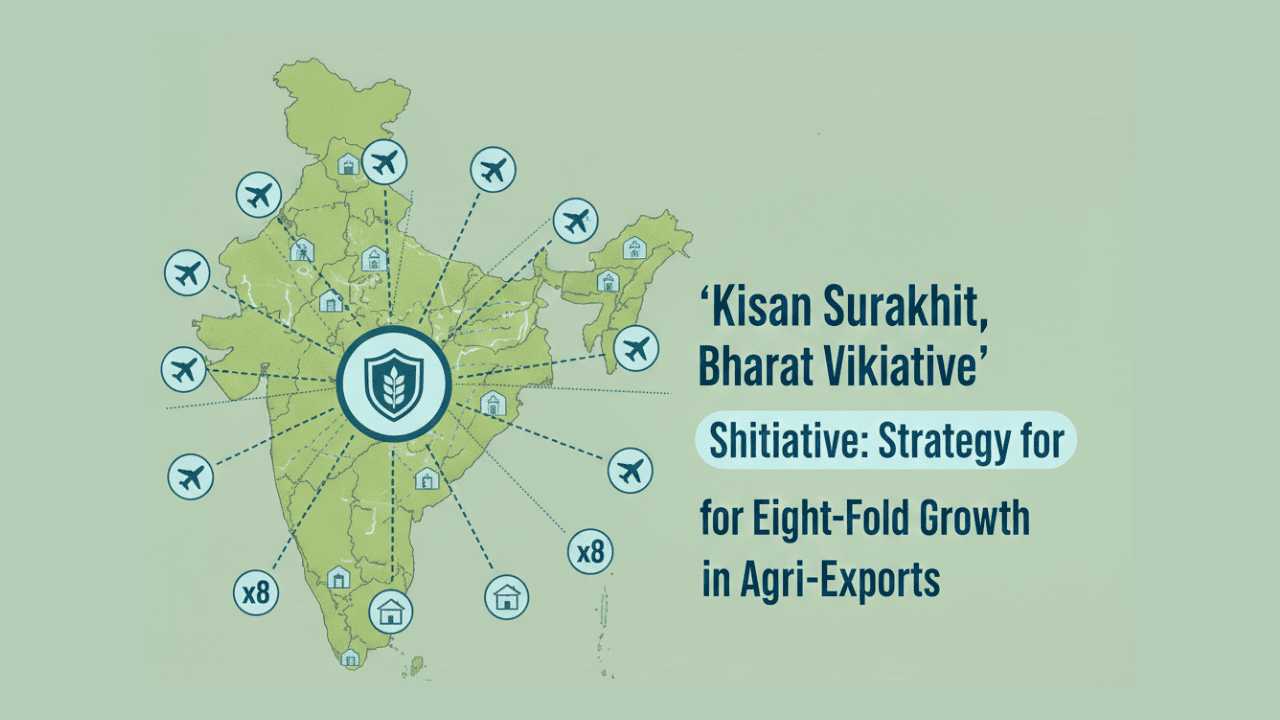
The Ministry of Agriculture and Farmers’ Welfare has unveiled the ‘Kisan Surakshit, Bharat Viksit’ initiative. Formulated as a cornerstone of the Union Budget 2026-27, this ambitious mission sets a rigorous target of achieving an eight-fold growth in agricultural exports by 2047. The initiative moves beyond traditional commodity exports, focusing instead on high-value, processed, and “identity-preserved” agricultural products. By integrating the concepts of “Lab to Land” and “Farm to Foreign,” the government is building a robust export pipeline that aims to take India’s agri-export valuation from the current $53 billion to an unprecedented $400 billion in the next two decades.
The ‘Kisan Surakshit’ (Protected Farmer) philosophy recognizes that for India to become a global food powerhouse, the primary producer must be shielded from market volatility and climate risks. The strategy relies on a “Viksit” (Developed) framework that emphasizes value addition at the source, ensuring that the lion’s share of the export premium stays in the hands of the farmer. As the ‘Reform Express’ pivots toward the rural heartland, this initiative is poised to redefine India’s role from a supplier of raw staples to a preferred global partner for premium, sustainable, and high-quality food products.
The VIKSIT Acronym: Six Vectors of Export Acceleration
The Department of Commerce and APEDA have adopted the VIKSIT framework to drive this eight-fold growth. This strategic pathway is designed to overcome ecosystem constraints and unlock the nation’s latent export potential through six critical vectors:
- V – Value Addition and Volume-led Growth: Moving away from bulk exports of rice and wheat toward processed items like protein concentrates, organic baby food, and specialty flours.
- I – Inclusive Industrial Development: Establishing Export-Oriented Clusters in Tier-II and Tier-III towns to integrate small and marginal farmers into the global value chain.
- K – Knowledge and Capacity Building: Utilizing the Viksit Krishi Sankalp Abhiyan to train 1.5 crore farmers in global phytosanitary standards and “Good Agricultural Practices” (GAP).
- S – Sustainable Supply Chains: Implementing “Green Logistics” and traceability systems that meet the stringent environmental standards of the EU and North American markets.
- I – Infrastructure Investments: Directing the ₹1 lakh crore Agriculture Infrastructure Fund (AIF) toward specialized cold storages, irradiation centers, and air-cargo hubs.
- T – Technology Enablement: Deploying Bharat-VISTAAR, an AI-powered advisory system, to help farmers align their crop cycles with global demand forecasts.
Focus on High-Value ‘Money Crops’ and Allied Sectors
The strategy identifies a major shift from food security staples to “Money Crops” that command higher prices in international markets. The 2026-27 Budget has specifically incentivized the production and processing of nuts, cocoa, and exotic fruits.
The growth strategy focuses on three high-potential segments:
- Horticulture and Floriculture: A dedicated program to rejuvenate old orchards and expand high-density cultivation of walnuts, almonds, and pine nuts in the Himalayan region to meet the soaring global demand for superfoods.
- Marine and Dairy Products: With the fisheries sector already contributing significantly to GVA, the initiative aims to double the export of value-added marine products like frozen shrimp and canned tuna through modern processing zones in coastal Odisha and Tamil Nadu.
- The Turmeric and Spice Mission: Aiming for $1 billion in turmeric exports by 2030, the newly formed National Turmeric Board is providing farmers with high-curcumin seeds and advanced curing technology to maintain India’s 60% global market share.
Building Resilience: The ‘Kisan Surakshit’ Shield
To support such aggressive export targets, the government has strengthened the safety net for farmers. The Pradhan Mantri Fasal Bima Yojana (PMFBY) has been reoriented to cover “Export Risk”—protecting farmers not just from crop failure but from sudden international price crashes or trade embargoes.
Furthermore, the Digital Agriculture Benefit Transfer (DABT) now rewards farmers for performance-based sustainability. Farmers who adopt low-carbon practices or organic certification receive “Green Premiums” directly into their bank accounts. This ensures that the “Surakshit” (Safe) aspect of the mission provides the financial stability required for farmers to experiment with export-grade varieties without the fear of bankruptcy.
Infrastructure and Global Market Access
To achieve eight-fold growth, the government is expanding the National Single Window System (NSWS) to include export documentation. This “One-Stop-Shop” allows a farmer-producer organization (FPO) to secure quality certifications, customs clearances, and logistics booking on a single platform.
The India-UK Free Trade Agreement (FTA), signed in July 2025, serves as a blueprint for this expansion, granting duty-free access to 95% of Indian agri-exports. Similar frameworks are being finalized with the European Union and the Gulf Cooperation Council (GCC). By participating as a Partner Country at Gulfood 2026, India has already demonstrated its readiness to supply premium, branded food products under the “BHARAT” pavilion, showcasing startups that use AI for real-time quality grading of perishables.
Conclusion: Harvesting the Vision of 2047
The ‘Kisan Surakshit, Bharat Viksit’ initiative is a bold re-imagining of Indian agriculture. It treats the farm not just as a source of food, but as a high-tech manufacturing unit for the world. By focusing on value addition, technological integration, and inclusive growth, the government is ensuring that the path to a $30 trillion economy is paved by the prosperity of its 14 crore farming households.
As the “Lab to Land” mission converts scientific research into exportable surplus, the eight-fold growth target appears not just achievable, but inevitable. The Indian farmer is no longer a silent spectator of global trade; through this initiative, they have become the primary driver of India’s journey toward becoming a developed superpower—a true Viksit Bharat.