
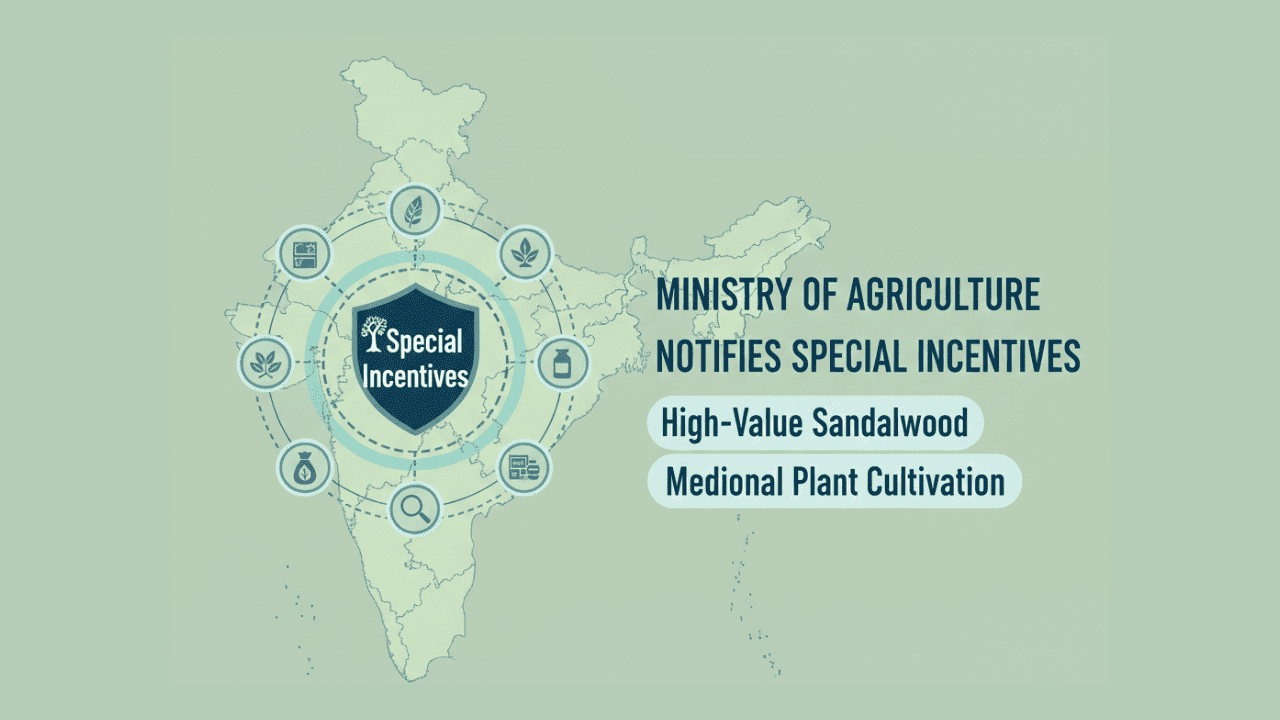
NEW DELHI – In a move to reclaim India’s status as a global leader in high-value forestry and traditional medicine, the Ministry of Agriculture and Farmers’ Welfare, in collaboration with the Ministry of AYUSH, has officially notified a series of special incentives for sandalwood and medicinal plant cultivation. Announced during the Union Budget 2026-27 under the ‘Viksit Bharat’ roadmap, these incentives aim to diversify farmer incomes and restore the “glory of the Indian sandalwood ecosystem.” With the global sandalwood market projected to exceed $500 million by 2030, the government is pivoting toward a “high-value crop strategy” that combines legislative deregulation with robust financial support.
The notification addresses long-standing bottlenecks in the sector, particularly the “draconian” regulations that previously made harvesting and transporting sandalwood a legal nightmare for private growers. By treating sandalwood as a “farm produce” rather than a restricted forest item, the government is encouraging the transition of degraded and coastal lands into profitable “Scented Gold” plantations.
The Sandalwood Revival Mission: ‘Santalum Album’ 2.0
The new framework focuses on creating a “trust-based” environment for sandalwood growers, specifically targeting the coastal regions and southern states like Karnataka and Tamil Nadu.
Key Incentives and Policy Shifts:
- Financial Assistance for Saplings: The government has allocated part of a ₹350 crore fund specifically for high-value crops to provide subsidized, high-yielding saplings to farmers.
- Deregulation of Harvesting: In partnership with State Governments, the Centre has notified an easing of conditions for the cutting, sale, and marketing of sandalwood trees. This “Ease of Harvesting” allows farmers to sell their produce in external markets without navigating through multiple forest department permits.
- Plantation Security & Insurance: For the first time, sandalwood plantations will be eligible for credit-linked insurance, protecting farmers against illegal logging (theft), pests, and diseases.
- Research and Host-Plant Synergy: The Indian Council of Forestry Research and Education (ICFRE) will provide technical advisory on “Host-Plant Species” (like pigeon pea and Cassia siamea) that optimize the growth and oil content of sandalwood trees.
Scaling Medicinal Plants: Convergence with ‘BioPharma SHAKTI’
Parallel to the sandalwood push, the government has announced a massive scale-up for the medicinal plant sector, integrating it with the ₹10,000 crore ‘BioPharma SHAKTI’ mission and the Ministry of AYUSH’s export strategy.
[Image showing a drone spraying nutrients over a medicinal plant cluster in India]
Strategic Support for Medicinal Growers:
- Certification & Export Relief: The Ministry of Agriculture has notified new provisions for the certification of medicinal plants, ensuring that Indian-grown herbs like Ashwagandha, Tulsi, and Giloy meet international Good Agricultural and Collection Practices (GACP).
- AYUSH Pharmacy Upgrades: To create domestic demand, the government is upgrading 7 existing and establishing 3 new NIPERs (National Institutes of Pharmaceutical Education and Research) and enhancing AYUSH pharmacies, which will prioritize sourcing raw materials from local farmers.
- Medical Tourism Hubs: Five new medical tourism hubs with integrated AYUSH centers have been announced, which will serve as direct retail and showcase outlets for premium medicinal plant products.
- Rural Supply Chain Strengthening: Under the ‘Viksit Bharat G RAM G’ framework, specialized storage and drying units are being set up at the village level to prevent post-harvest losses of delicate medicinal herbs.
Economic Impact: From Imports to Self-Reliance
The Finance Ministry noted that India currently meets only 30% of its domestic sandalwood demand, with state entities like Karnataka Soaps and Detergents Ltd. (KSDL) ironically forced to import sandalwood oil from Australia. These new incentives are designed to reverse this trend.
- Import Substitution: By restoring the domestic sandalwood ecosystem, India aims to save millions in foreign exchange currently spent on importing Indian varieties grown abroad.
- Premium Branding: The government has set a 2030 target to transform Indian Sandalwood and AYUSH products into premium global brands, leveraging their deep links to India’s social and cultural heritage.
- Regional Specialization: While sandalwood is promoted in coastal and southern zones, the notification also mentions support for Agarwood in the Northeast and high-value nuts in hilly terrains, creating a diversified “High-Value Map” of India.
Conclusion: Cultivating Prosperity through Heritage
The notification of incentives for sandalwood and medicinal plants represents a strategic merger of traditional heritage and modern commerce. By removing the fear of legal repercussions and providing the “safety net” of insurance and scientific advisory, the government is inviting a new generation of “Agri-Entrepreneurs” into the fold.
As the ‘Bharat VISTAAR’ AI tool begins providing region-specific advisory for these high-value crops, the Indian farm is set to become more than a source of food—it will be a source of luxury, wellness, and global prestige. In the journey toward Viksit Bharat 2047, the “Scent of India” and its ancient healing wisdom will once again lead the global market, ensuring that the Indian farmer is both “Surakshit” (Safe) and “Samriddh” (Prosperous).