
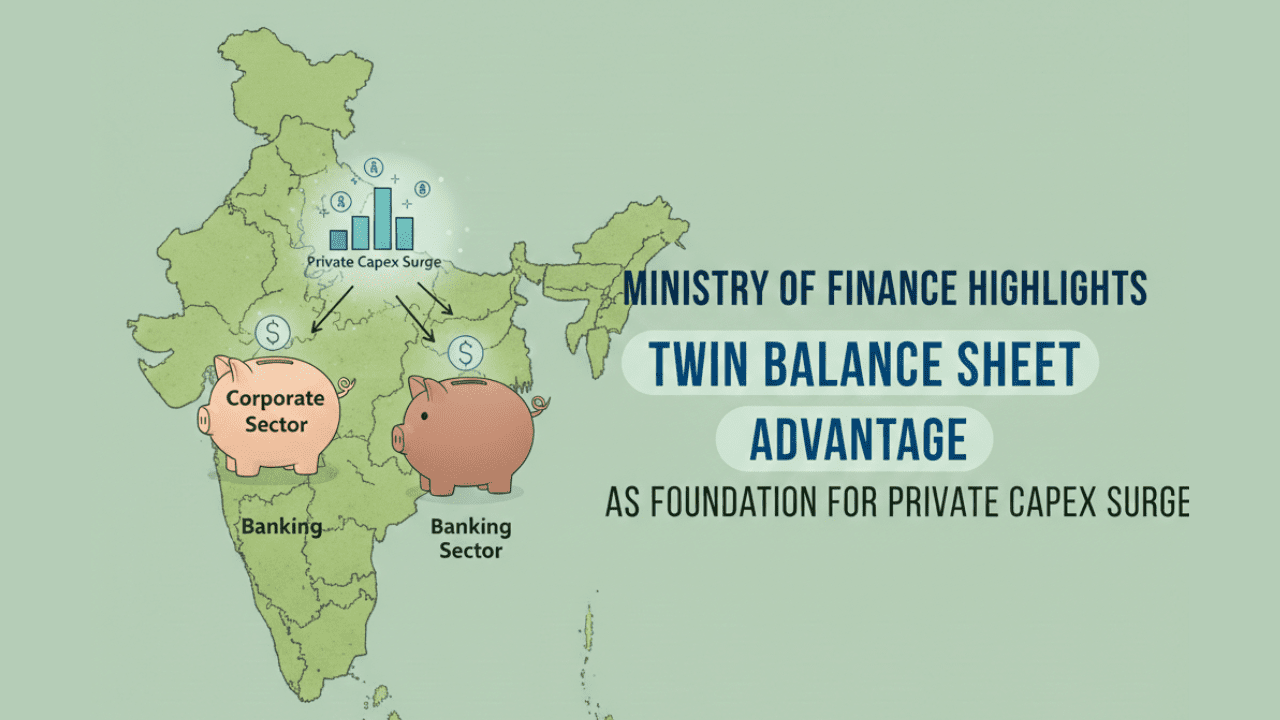
NEW DELHI – In a significant assessment of India’s macroeconomic health, the Ministry of Finance has declared that the Indian economy has successfully transitioned from the “Twin Balance Sheet Problem” of the previous decade to a “Twin Balance Sheet Advantage.” Following the tabling of the Economic Survey 2025-26, Finance Minister Nirmala Sitharaman noted that the simultaneous strengthening of both corporate and banking sector balance sheets is now providing the “financial firepower” necessary to trigger a long-awaited surge in private capital expenditure (capex). With the banking sector reporting record-low non-performing assets (NPAs) and the corporate sector reaching its lowest debt-to-equity levels in fifteen years, the government believes the stage is set for a multi-year private investment cycle that will put India’s growth on a fast track toward a $30 trillion economy by 2047.
The “Twin Balance Sheet Advantage” is viewed as the structural foundation for the Union Budget 2026-27‘s growth strategy. As the government continues its own aggressive public capex push (allocated at ₹12.2 lakh crore), the healthy state of private balance sheets ensures that “crowding-in” is now a reality rather than a projection. The Finance Ministry’s report emphasizes that the “clean-up” phase of the Indian economy is officially over, and the “expansion” phase has begun, led by high-growth sectors such as semiconductors, green energy, and electronics manufacturing.
From Crisis to Advantage: The 2014-2026 Turnaround
The transition from a “problem” to an “advantage” marks the conclusion of a decade-long repair mission. In 2014-15, India faced a crisis where over-leveraged infrastructure companies were unable to pay debts, which in turn crippled the lending capacity of public sector banks (PSBs) due to mounting bad loans.
The Transformation Metrics:
- Banking Sector Health: Gross NPAs of the banking system have plummeted to a record low of 2.3% as of September 2025, down from nearly 12% in 2017-18.
- Corporate Deleveraging: The debt-to-equity ratio of private non-financial companies has fallen from 55% to approximately 35%, indicating that Indian firms have utilized the last few years to clear their books and are now “lean and hungry” for expansion.
- Bank Profitability: Public Sector Banks are on track to cross a historic combined profit threshold of ₹2 lakh crore in the current financial year (FY26), providing them with the capital buffers needed to support aggressive credit growth.
Foundation for a Private Capex Surge
The Ministry of Finance highlights that the current environment is unique because, for the first time in nearly 15 years, both the “ability to lend” and the “willingness to borrow” have aligned. This synergy is expected to drive a 12-15% growth in private investment in the coming fiscal year.
1. Crowding-In Effect
The sustained high public capex by the Central Government (over ₹10 lakh crore annually for the last three years) has created demand in core sectors like steel, cement, and heavy machinery. With their balance sheets now healthy, private players in these traditional sectors are announcing massive brownfield and greenfield expansions to meet this government-led demand.
2. Credit Multiplier
With bank capital adequacy ratios staying healthy at 15.9%, banks are no longer in a “defensive” mode. Credit growth to the corporate sector has picked up to 12-15%, specifically targeting the MSME and manufacturing sectors. The Finance Ministry notes that banks are now competing to fund high-quality infrastructure projects, a sharp reversal from the “credit squeeze” seen during the mid-2010s.
3. New-Age Sector Leadership
The private capex surge is not just limited to traditional industries. The “Advantage” is fueling massive investments in:
- Greenfield Data Centers: Benefiting from the new tax holidays and “Safe Harbour” provisions.
- Semiconductor Fabrication: Driven by the ISM 2.0 mission and the need for supply chain resilience.
- Renewable Energy & EVs: Where private capital is leading the transition toward a net-zero economy.
Structural Reforms that Fueled the Advantage
The Finance Ministry attributes this turnaround to a “4R Strategy”—Recognize, Recapitalize, Resolve, and Reform—along with several key legislative pillars:
- Insolvency and Bankruptcy Code (IBC): Which provided a time-bound mechanism for stressed asset resolution, returning over ₹3 lakh crore to the banking system.
- National Asset Reconstruction Company (NARCL): Which effectively “cleaned” bank books by taking over legacy bad debts.
- Corporate Tax Cuts: The 2019 tax reforms allowed companies to retain more earnings, which they used for deleveraging.
- Digital Public Infrastructure (DPI): Allowing for better credit assessment and reducing the “information asymmetry” that previously led to bad lending decisions.
Conclusion: Sustaining the Investment Momentum
The highlight of the “Twin Balance Sheet Advantage” is a signal to global and domestic investors that the Indian financial system is at its most resilient. By fixing the plumbing of the economy, the government has ensured that the “Reform Express” has a stable track to run on.
However, the Ministry remains vigilant. As the Finance Minister noted, the focus now shifts to “Financialization of Savings,” ensuring that household capital continues to flow into productive investments through both banks and capital markets. With the Income Tax Act, 2025 set to simplify the investment landscape further from April 1, 2026, the “Twin Balance Sheet Advantage” is expected to be the primary engine of India’s growth story for the next decade, ensuring that the dream of Vikas (Development) is backed by solid Vitta (Finance).