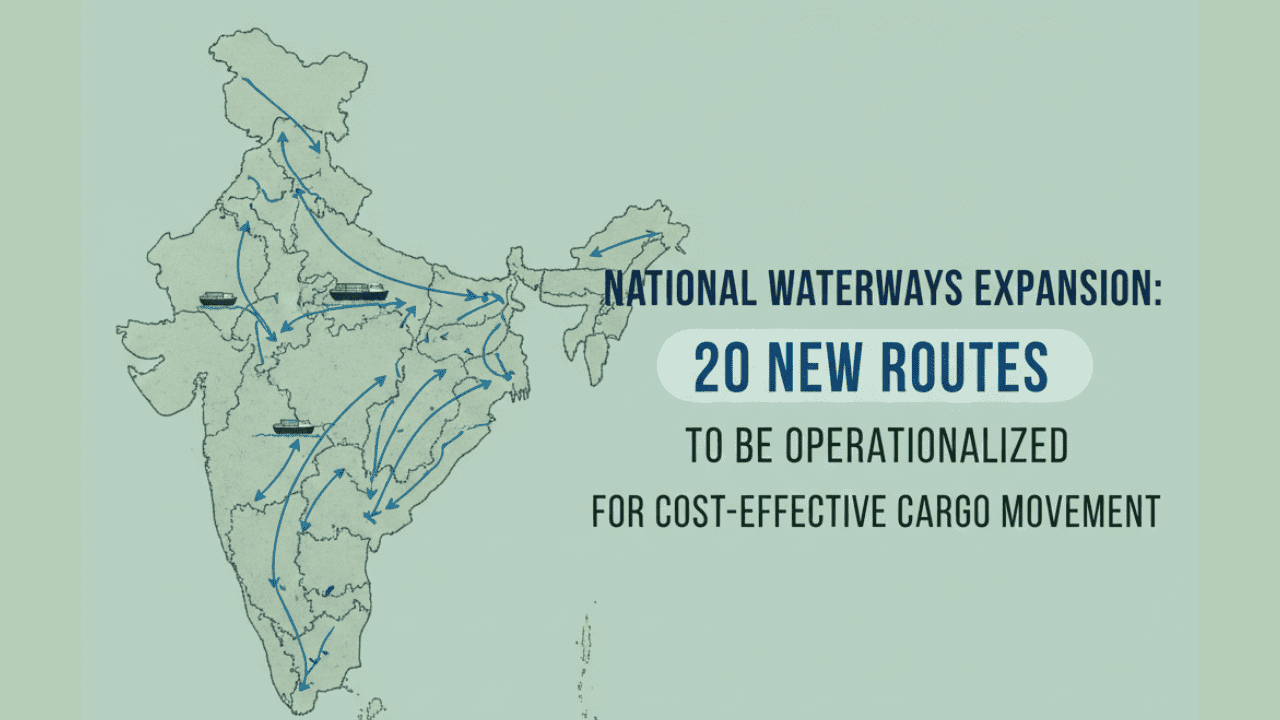
The Ministry of Ports, Shipping, and Waterways has announced the operationalization of 20 new National Waterway (NW) routes by the end of the 2026-27 fiscal year. This strategic expansion, a core component of the Union Budget 2026-27, is designed to provide a high-capacity, fuel-efficient, and cost-effective alternative to traditional rail and road transport. By leveraging India’s vast network of navigable rivers and canals, the government aims to reduce the national logistics cost from the current 13-14% of GDP to a globally competitive 8% by 2030. The Prime Minister has described this initiative as the “Blue Arteries” of Viksit Bharat, essential for connecting the resource-rich hinterlands of the East and Northeast to the global maritime corridors.
The decision to operationalize 20 new routes follows the successful proof-of-concept on National Waterway-1 (Ganga) and National Waterway-2 (Brahmaputra). With an increased budgetary allocation of ₹2,600 crore specifically for the Inland Waterways Authority of India (IWAI), the focus is now on the “Phase-II” development of the 111 declared National Waterways. This expansion is expected to shift over 150 million tonnes of cargo—ranging from coal and iron ore to agricultural produce and containerized goods—from congested highways to the riverine network, significantly reducing the country’s carbon footprint.
Strategic Infrastructure and Modernization
The 20 new routes have been selected based on their potential to integrate with existing industrial clusters and multi-modal logistics parks. The government is not merely dredging rivers but is building a comprehensive “Digital and Physical Infrastructure” for the waterways.
Key infrastructure developments for these routes include:
- Multi-Modal Terminals (MMTs): The establishment of smart terminals equipped with automated cargo-handling systems. These terminals will act as “Intermodal Hubs,” allowing for seamless transfer between water, rail, and road.
- Night Navigation Systems: To ensure 24/7 operational capability, the IWAI is deploying advanced satellite-based navigation and river information systems (RIS) across all 20 new routes.
- Sustainable Dredging: Implementation of “Assured Depth” contracts with private players to maintain a Least Available Depth (LAD) of 2.5 to 3.0 meters throughout the year, ensuring the smooth movement of large 2,000-tonne vessels.
- Green Vessel Incentives: The 2026-27 Budget introduces a “Green Ship Subsidy” for inland vessels powered by LNG, electricity, or green hydrogen, aligning the expansion with India’s Net Zero commitments.
Impact on Regional Economies and Trade
The operationalization of these routes will provide a massive stimulus to regional economies, particularly in the landlocked states of Central and Eastern India.
The expansion targets three primary economic zones:
- The Eastern Mineral Belt: New routes on the Mahanadi and Brahmani rivers will connect the coal and iron ore mines of Odisha directly to the Paradip and Dhamra ports, lowering energy costs for steel and power plants.
- The Indo-Bangladesh Protocol (IBP) Route Expansion: Strengthening the riverine link between West Bengal and the Northeast states through Bangladesh. This “Transit-cum-Trade” corridor is set to reduce the distance to Agartala and Guwahati by over 60% compared to the Siliguri corridor.
- The Southern Peninsula Links: New routes in Kerala and Tamil Nadu will facilitate the movement of fertilizers, food grains, and petroleum products, reducing the heavy truck traffic on the coastal highways.
Efficiency: The Logistics Advantage
From a commercial perspective, inland water transport (IWT) offers an unbeatable cost advantage. While the cost of moving cargo by road is approximately ₹2.50 per tonne-km and ₹1.36 by rail, IWT costs a mere ₹1.06 per tonne-km.
Furthermore, one barge on a National Waterway can carry the equivalent of 50 to 100 trucks, drastically reducing road congestion and the wear and tear of highway infrastructure. The Ministry of Shipping has also notified the National Waterways (Movement of Goods) Rules, 2026, which simplifies the documentation and tolling process, treating riverine movement on par with “Green Corridors” for expedited clearance. This “ease of movement” is a vital fulfillment of the government’s Kartavya (Duty) to enhance industrial productivity.
Integration with Gati Shakti and Sagarmala
The expansion is fully integrated with the PM Gati Shakti National Master Plan, ensuring that the new waterway terminals are located within 50 km of dedicated freight corridors or national highways. This “Port-led Prosperity” model, under the Sagarmala initiative, ensures that the hinterland is effectively connected to the maritime gateways.
The government is also encouraging private sector participation through the IWT-PPP model, where private operators can manage terminals and operate vessel fleets under long-term concessions. This has already attracted interest from global logistics majors, who see India’s rivers as the next big frontier for sustainable supply chain management.
Conclusion: Navigating Toward a Developed India
The operationalization of 20 new National Waterway routes is a landmark moment in India’s infrastructure story. By reclaiming the historic importance of its river systems, India is building a logistics network that is not only cost-effective but also environmentally sustainable. These “Blue Arteries” will ensure that the fruits of economic growth reach the deepest corners of the country, empowering local industries and farmers with global market access.
As the first set of these routes becomes operational in late 2026, the impact on India’s trade competitiveness will be immediate. The transition to water-based cargo movement is a testament to the “Reform Express” philosophy—innovating, integrating, and accelerating. In the journey toward Viksit Bharat 2047, the National Waterways will be the silent, powerful currents that carry the nation toward its goal of becoming a $30 trillion economic superpower.