
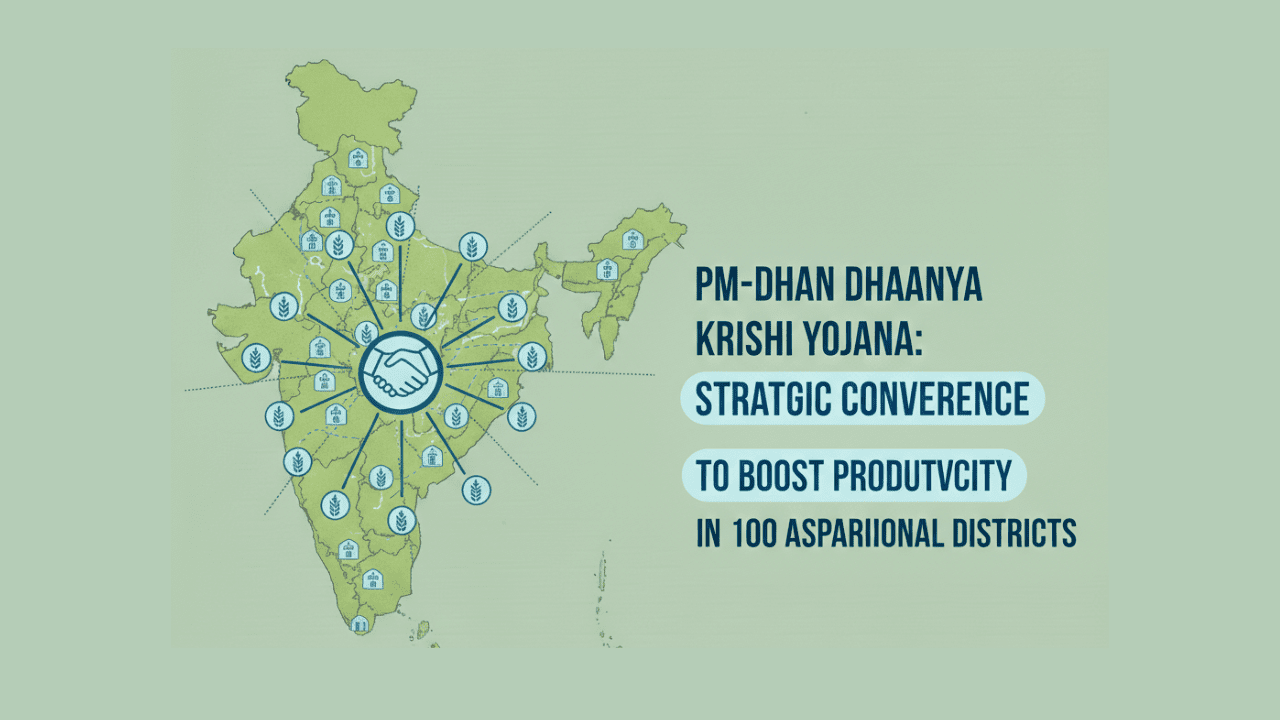
NEW DELHI – In a move that signals a paradigm shift in rural development, the Government of India has operationalized the Prime Minister Dhan-Dhaanya Krishi Yojana (PMDDKY). Approved by the Union Cabinet with an annual outlay of ₹24,000 crore for a period of six years (FY 2025-26 to 2030-31), this mission targets 100 selected Aspirational Agricultural Districts that have historically lagged in yield and credit access. Unlike traditional standalone schemes, PMDDKY is built on a “Saturation-based Convergence” model, integrating 36 existing Central schemes from 11 different Union Ministries into a unified district-level plan. By focusing on districts with low productivity, moderate cropping intensity, and below-average credit flow, the government aims to directly uplift 1.7 crore farmers, transforming underperforming regions into hubs of agricultural excellence and self-reliance (Atmanirbhar Bharat).+2
The scheme draws its strategic inspiration from NITI Aayog’s successful Aspirational Districts Programme but is exclusively laser-focused on agriculture and allied sectors. The Prime Minister has emphasized that PMDDKY is not just about increasing production, but about ensuring “Energy, Equity, and Economy” in the farm sector through scientific intervention and institutional synergy.
The 3Cs Framework: Convergence, Collaboration, and Competition
To ensure the mission does not become another bureaucratic exercise, PMDDKY operates on the 3Cs Framework, which has been the hallmark of recent governance reforms.
- Convergence: Instead of launching new initiatives, the Yojana merges the budgets and goals of 36 schemes, including PM-Kisan (Direct Benefit Transfer), PM Krishi Sinchayee Yojana (Irrigation), and PM Fasal Bima Yojana (Insurance). This ensures that a single farmer in an aspirational district receives a “bundle” of benefits simultaneously.
- Collaboration: Implementation is driven by a District Dhan Dhaanya Samiti, led by the District Collector and comprising progressive farmers and experts from agricultural universities. This samiti is responsible for crafting a District Agriculture and Allied Activities Plan tailored to local soil, climate, and cropping patterns.+1
- Competition: Districts are ranked monthly based on their progress across 117 Key Performance Indicators (KPIs). This healthy competition, displayed on a dedicated public dashboard, motivates district administrations to innovate and accelerate project delivery.+1
Five Core Objectives for Agri-Transformation
The mission addresses the structural “pain points” of Indian agriculture through five clearly defined pillars:
- Enhancing Productivity: Boosting yields by addressing local bottlenecks, improving access to quality climate-resilient seeds, and promoting balanced fertilizer use.
- Crop Diversification: Encouraging a shift from water-guzzling crops to pulses, oilseeds, and horticulture, which are more suited to the local agro-climatic zones.
- Post-Harvest Infrastructure: Developing a network of storage facilities, warehouses, and cold chains at the Panchayat and Block levels to minimize wastage and improve the bargaining power of small farmers.
- Irrigation Expansion: Promoting “Per Drop More Crop” through the adoption of micro-irrigation (drip and sprinkler) technologies and the rejuvenation of traditional water bodies.
- Credit Facilitation: Ensuring the seamless flow of both short-term and long-term institutional credit, specifically targeting those who have been outside the formal banking system.
Integration of Allied Sectors and Rural Resilience
Recognizing that farm income is often volatile, PMDDKY places heavy emphasis on the Livestock, Dairy, and Fisheries sectors. By creating disease-free zones and promoting value-addition in these allied fields, the government is building a “Rural Resilience” shield for farmers.+1
The Union Budget 2026-27 has further strengthened this by proposing the development of a ‘Grameen Credit Score’ framework by Public Sector Banks. This will allow members of Self-Help Groups (SHGs) and marginal farmers in these 100 districts to access loans based on their transaction history rather than just physical collateral. Furthermore, the convergence with the National Mission on High Yielding Seeds ensures that these aspirational districts are the first to receive the latest bio-fortified and heat-tolerant seed varieties.
Conclusion: A New Blueprint for Rural Prosperity
The PM-Dhan Dhaanya Krishi Yojana is a bold experiment in “Targeted Governance.” By moving away from a one-size-fits-all approach and empowering local Samitis to solve local problems, the government is ensuring that the path to a $30 trillion Viksit Bharat starts from the fields of its most challenged districts. The synergy between 11 ministries ensures that every rupee spent is leveraged for maximum impact, creating a “Saturation Effect” that was previously unseen in rural development.+1
As the first cycle of monthly rankings begins in early 2026, the 100 Aspirational Districts are no longer seen as “laggards” but as the “frontiers” of India’s next Green Revolution. With the integration of AI-powered advisory and a robust digital monitoring stack, PMDDKY is ensuring that the Indian farmer is not just “Surakshit” (Safe) but is a prosperous partner in the nation’s journey toward global leadership.