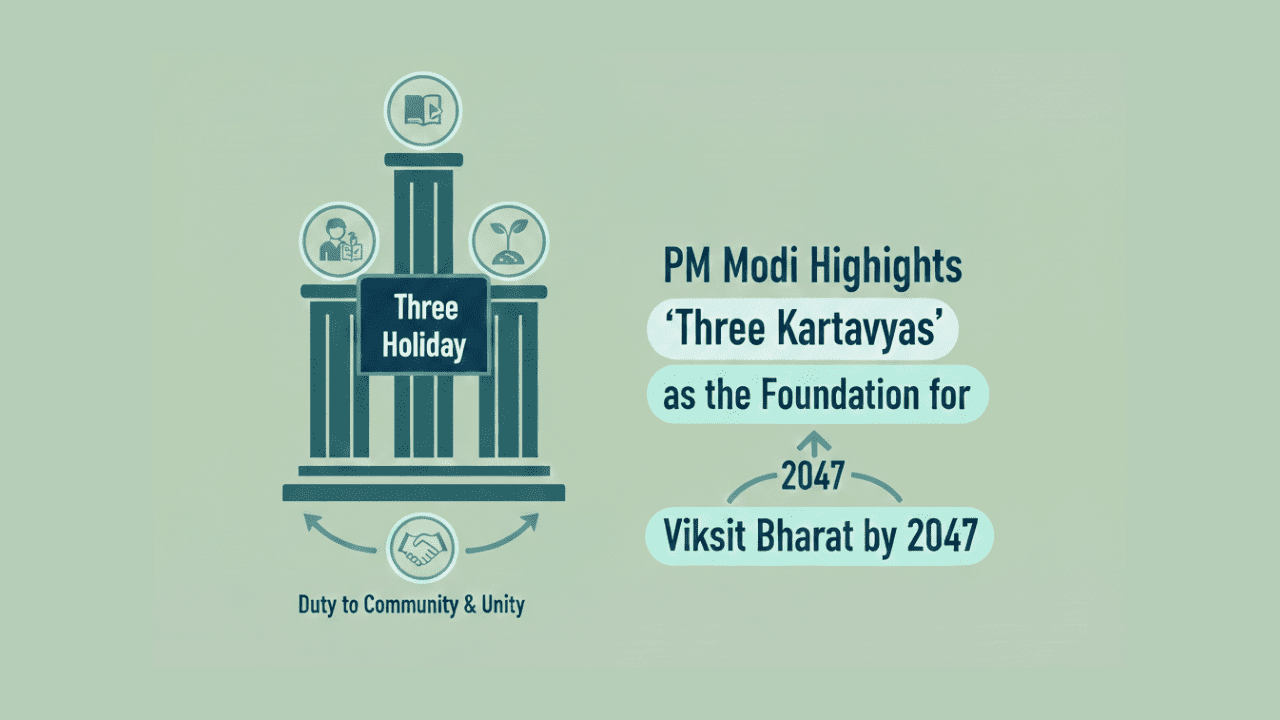
NEW DELHI – In a landmark address following the presentation of the Union Budget 2026-27, Prime Minister Narendra Modi outlined a transformative vision for India’s future, anchored by the framework of the ‘Three Kartavyas’ (Three Duties). Speaking from the newly inaugurated Kartavya Bhawan, the Prime Minister emphasized that these duties are not merely policy goals but the fundamental pillars required to propel India into the league of developed nations by the centenary of its independence in 2047.
The Prime Minister reiterated that the journey toward a $30 trillion economy necessitates a shift from “rights-based governance” to “duty-based growth,” where the government and citizens work in tandem to achieve national excellence.
The Framework of the Three Kartavyas
The Union Budget 2026-27, described by the Prime Minister as a “Yuva Shakti-driven Budget,” is built upon three strategic pillars designed to ensure long-term resilience and inclusive prosperity.
1. Accelerating and Sustaining Economic Growth
The first Kartavya focuses on enhancing productivity and building a self-reliant manufacturing ecosystem. Key initiatives under this pillar include:
- India Semiconductor Mission (ISM) 2.0: A major push for full-stack Indian Intellectual Property (IP) in chip manufacturing.
- BioPharma SHAKTI Mission: A ₹10,000 crore outlay aimed at making India a global hub for biologics and biosimilars.
- Rare Earth Corridors: Development of specialized mining and processing zones in Odisha, Andhra Pradesh, and Tamil Nadu to reduce critical import dependencies.
2. Fulfilling Aspirations and Building Capacity
The second Kartavya centers on empowering the Indian workforce and the youth. The Prime Minister highlighted that a developed nation is built by developed citizens.
- Establishment of Regional Medical Hubs: Five new hubs to position India as a premier destination for global medical tourism.
- Allied Health Professionals: A plan to add 1 lakh certified professionals to the healthcare workforce over five years.
- PM-SETU: A program dedicated to upgrading Industrial Training Institutes (ITIs) to meet the demands of Industry 4.0.
3. Inclusive Development (Sabka Saath, Sabka Vikas)
The third Kartavya ensures that the benefits of growth reach the last mile, specifically focusing on farmers, women, and the underprivileged.
- Bharat-VISTAAR: An AI-powered multilingual platform to provide real-time agricultural advisory and integrate ICAR data for farmers.
- SME Growth Fund: A ₹10,000 crore fund to provide equity support to growth-stage MSMEs.
- Mahatma Gandhi Gram Swaraj Initiative: Strengthening the Khadi and handloom sectors through global branding and modern skilling.
Governance and Fiscal Discipline
Prime Minister Modi noted that for the first time, the Budget was prepared in Kartavya Bhawan, symbolizing a conscious shift toward capability building. Despite high capital expenditure, the government remains committed to fiscal discipline, with the fiscal deficit estimated at 4.3% of GDP for FY 2026-27.
The Prime Minister also touched upon the New Income Tax Act, set to take effect from April 1, 2026, which aims to simplify compliance and reduce the multiplicity of proceedings, thereby fostering a “trust-based” relationship between the taxpayer and the state.
Conclusion: A Roadmap for a Developed India
The ‘Three Kartavyas’ framework marks a pivotal moment in India’s economic history. By balancing aggressive industrial growth with deep-rooted social inclusion, the government aims to create a “human-centric” economic model. As Prime Minister Modi concluded, these three duties serve as the “Reform Express” that will provide the energy and momentum required to transform the aspirations of 140 crore Indians into a reality of a sovereign, prosperous, and developed Viksit Bharat.