
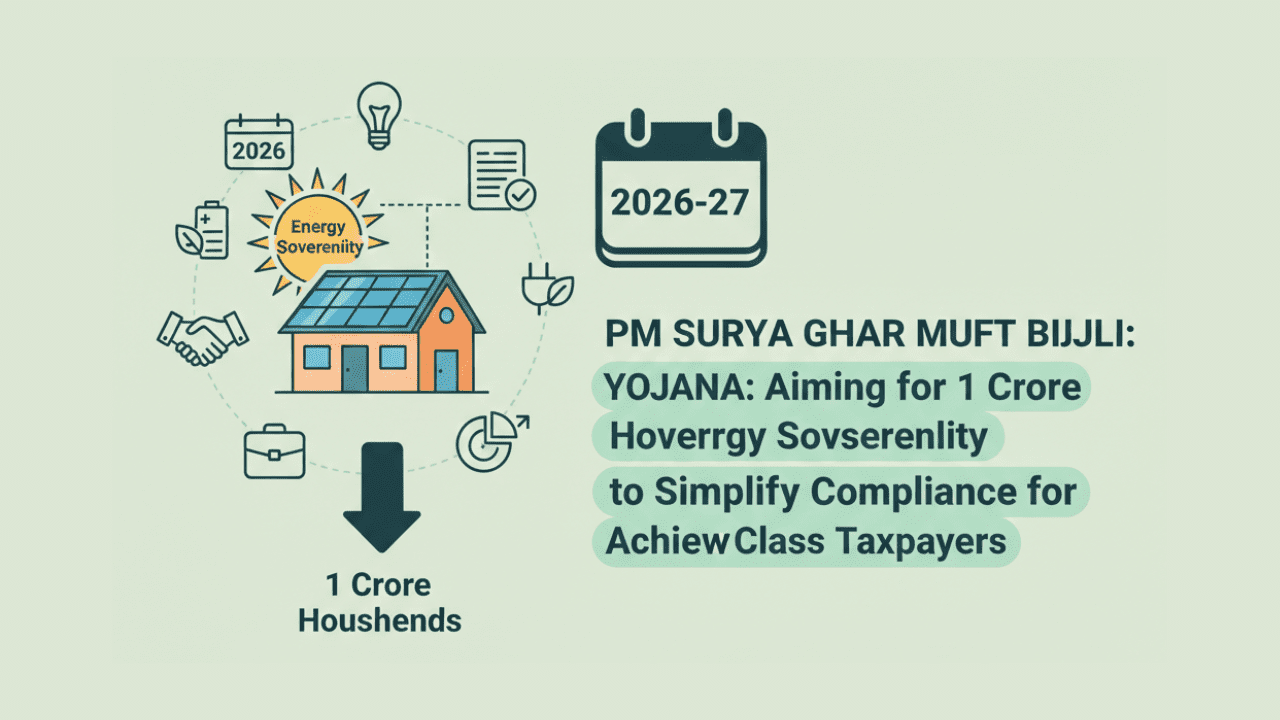
NEW DELHI – In a move that signals a decisive shift toward decentralized renewable energy, the Government of India has ramped up the implementation of the PM Surya Ghar Muft Bijli Yojana. Launched with an initial outlay of ₹75,021 crore, the scheme has reached a critical milestone in early 2026, with over 28 lakh households already benefiting from solar installations. During the presentation of the Union Budget 2026-27, the government reaffirmed its ambitious target of powering one crore households with rooftop solar by March 2027. This initiative is not merely about providing electricity; it is a strategic maneuver to grant “Energy Sovereignty” to the Indian middle class and the poor, transforming individual households from passive consumers into active “prosumers” who generate their own power and earn from the surplus.
The Prime Minister has described this mission as a “Green Revolution for the Indian Rooftop.” By leveraging India’s vast solar potential, the government aims to reduce the national carbon footprint by 720 million tonnes of CO2 equivalent over the next 25 years. Beyond the environmental impact, the scheme is expected to save the government approximately ₹75,000 crore annually in electricity subsidies and transmission losses. As the “Reform Express” carries this mission forward, the focus in 2026 has intensified on simplifying the “National Portal for Rooftop Solar” and ensuring that the financial benefits reach the last mile through seamless Direct Benefit Transfer (DBT).
The Core Promise: 300 Units of Free Electricity
The central attraction of the PM Surya Ghar Muft Bijli Yojana is the promise of up to 300 units of free electricity every month for participating households. For the average Indian family, this effectively translates to a “Zero Bill” lifestyle. The scheme is meticulously designed to match a household’s consumption with the appropriate solar plant capacity.
For a typical household consuming up to 150 units per month, a 1-2 kW system is recommended. Those consuming between 150 to 300 units are encouraged to install a 2-3 kW system. By generating electricity on their own roofs, families are insulated from future tariff hikes and grid instabilities. The Prime Minister emphasized that this 300-unit threshold was chosen specifically to cover the essential needs of a modern Indian home—powering fans, lights, a refrigerator, and educational devices—thereby directly improving the “Ease of Living.”
Revolutionary Subsidy Structure and Financial Support
To make solar energy affordable for the masses, the government has introduced one of the most generous subsidy frameworks in the global renewable sector. The Central Financial Assistance (CFA) is structured to provide the highest support to smaller systems, ensuring that lower-income families can participate without a heavy upfront burden.
As per the 2026 guidelines, the subsidy rates are as follows:
- For systems up to 2 kW: A subsidy of ₹30,000 per kW (Totaling up to ₹60,000).
- For additional capacity (from 2 kW to 3 kW): An additional ₹18,000 per kW.
- Maximum Subsidy: For systems of 3 kW or higher, the total central subsidy is capped at ₹78,000.
To cover the remaining cost, the government has partnered with nationalized banks to offer collateral-free, low-interest loans. These loans, currently pegged at around 7% interest (or roughly 0.5% above the prevailing Repo Rate), allow households to install solar units with a very low down payment. The Equated Monthly Installments (EMIs) are often structured to be lower than the household’s previous monthly electricity bill, making the transition “wallet-neutral” from day one.
Surplus Income: Turning Roofs into Revenue Streams
Energy Sovereignty under the PM Surya Ghar scheme extends beyond self-sufficiency to financial empowerment. Through the Net Metering mechanism, any excess electricity generated by the rooftop panels—beyond what the household consumes—is automatically fed back into the main power grid.
The local Distribution Company (DISCOM) tracks this exported power and provides credits to the consumer. For a 3 kW system, which can produce significantly more than 300 units during sunny months, a household can earn between ₹15,000 and ₹18,000 annually by selling this surplus. This transforms a residential rooftop into a micro-power plant, providing a steady stream of passive income for 25 years—the typical performance warranty period of modern solar panels. This “Income from the Sun” model is particularly transformative for retired individuals and rural families, providing a hedge against inflation.
Model Solar Villages and Local Empowerment
To catalyze the movement at the grassroots level, the government has launched the Model Solar Village initiative. One village in every district across India is being selected to become a pioneer in energy self-reliance. An allocation of ₹800 crore has been designated for this, with ₹1 crore provided to each selected village to install community-wide solar solutions.
These villages serve as living laboratories for “Energy Sovereignty,” demonstrating how localized power generation can fuel small-scale industries, power schools, and provide reliable street lighting. Furthermore, the scheme is a massive engine for job creation. The Ministry of New and Renewable Energy (MNRE) estimates that the installation and maintenance of 1 crore rooftop systems will create approximately 17 lakh direct jobs for solar technicians, engineers, and sales professionals, giving a significant boost to the “Green Workforce.”
Seamless Digital Integration: The National Portal
In line with the Digital India mission, the entire application-to-subsidy process is handled through the National Portal (pmsuryaghar.gov.in). The process has been designed to be “contactless” to eliminate middlemen:
- Registration: Users enter their state, DISCOM, and electricity consumer number.
- Feasibility Approval: The DISCOM reviews the request and grants approval online.
- Installation: The user selects a registered vendor from the portal to install the MNRE-approved panels.
- Inspection & Net Metering: After installation, the DISCOM installs a net meter and issues a commissioning certificate.
- Subsidy Claim: The subsidy is credited directly to the user’s bank account within 30 days of the certificate generation.
Conclusion: Lighting Up a Billion Dreams
The PM Surya Ghar Muft Bijli Yojana is more than a power scheme; it is a movement toward a more resilient and self-reliant India. By empowering 1 crore households to generate their own electricity, the government is democratizing the energy sector. This “bottom-up” approach ensures that the benefits of India’s solar revolution are not restricted to large industrial parks but are felt in the balconies and terraces of every Indian home.