
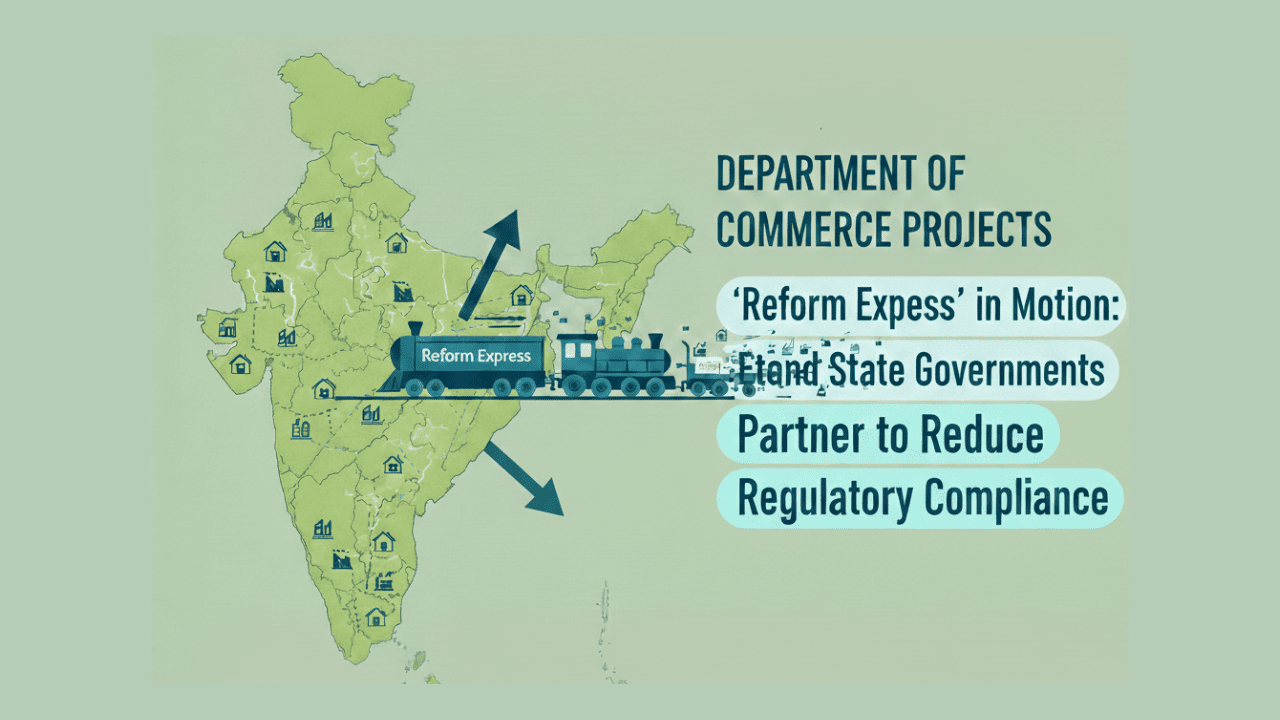
Building on the momentum of the Union Budget 2026-27, the Prime Minister has announced that India’s ‘Reform Express’ has entered a critical new phase of cooperative federalism. In a significant administrative breakthrough, the Central Government and various State Governments have finalized a unified framework to drastically reduce the regulatory compliance burden on businesses and citizens. This initiative, spearheaded by the Task Force on Compliance Reduction and Deregulation constituted in early 2025, aims to eliminate over 40,000 redundant compliances by the end of the 2026-27 fiscal year. By aligning central mandates with state-level execution, the government is creating a seamless “single-window” experience that transcends geographical and bureaucratic boundaries.
The ‘Reform Express’ is not just a catchphrase but a structural overhaul of India’s regulatory DNA. The Prime Minister emphasized that for India to reach its $30 trillion goal by 2047, the “cost of compliance” must be reduced to a global minimum. This partnership between the Centre and States is designed to replace “command-and-control” oversight with a “trust-based” governance model, ensuring that entrepreneurs spend more time innovating and less time navigating the labyrinth of paperwork.
Jan Vishwas 2.0: Decriminalizing the Business Landscape
A cornerstone of the 2026 reform agenda is the notification of the Jan Vishwas (Amendment of Provisions) Bill, 2025, popularly known as Jan Vishwas 2.0. This landmark legislation proposes amendments to 288 provisions across 16 Central Acts to decriminalize minor, technical, and procedural defaults.
Key features of the Jan Vishwas 2.0 framework include:
- Warning-First Model: For 76 different categories of offenses, the Bill introduces a “warning and improvement notice” for first-time offenders rather than immediate penalties.
- Administrative Adjudication: Minor offenses are being moved out of the criminal courts and into the hands of specialized Adjudicating Officers, significantly reducing the burden on the judiciary.
- Proportional Penalties: Imprisonment clauses are being replaced with graduated monetary penalties that reflect the gravity of the violation. For example, technical defaults under the Electricity Act now attract fines instead of the previous three-month jail term.
National Single Window System (NSWS) Expansion
To truly move the ‘Reform Express’ into Tier-II and Tier-III towns, the National Single Window System (NSWS) has been significantly expanded. As of February 2026, the platform integrates approval processes across 32 Central Departments and 29 State Governments, offering a staggering 7,435 state-level approvals through a single digital gateway.
The NSWS now features:
- KYA (Know Your Approval): An intelligent module that tells an entrepreneur exactly which licenses are needed based on their location and sector, preventing “regulatory surprises.”
- Integrated Document Repository: Once a document (like a PAN or Board Resolution) is uploaded, it is available to all participating state and central agencies, eliminating the need for repeated submissions.
- Automated Tracking: Real-time dashboards allow businesses to track the status of their permits, with “deemed approvals” triggered if a department fails to respond within the stipulated timeline.
States Leading the Charge: Competitive Federalism in Action
Under the Business Reforms Action Plan (BRAP) 2026, states are now competing to offer the leanest regulatory environment. The “Reform Express” has seen several states emerge as champions of deregulation:
- Andhra Pradesh & Gujarat: Both states have successfully implemented 100% online land registration and integrated environmental approvals with their industrial single-window systems.
- Maharashtra & Tamil Nadu: These states have digitized over 20 years of property and labor records, allowing for automated compliance verification for MSMEs.
- Uttar Pradesh: The state has introduced a “Nivesh Mitra” portal that has successfully processed over 8 lakh approvals, serving as a benchmark for large-scale digital governance.
The Central Government is supporting these efforts through the State Support Mission by NITI Aayog, which provides technical expertise and “Reform Grants” to states that successfully meet their deregulation targets. This creates a “Race to the Top” where states are incentivized to simplify their laws to attract global and domestic investment.
Reducing the ‘Inspector Raj’ through Digital Oversight
The 2026 reforms aim to finally dismantle the remnants of the ‘Inspector Raj’ by introducing Risk-Based Inspections. Rather than arbitrary physical visits, departments are now mandated to use a Central Inspection System (CIS).
Under this system:
- Algorithmic Selection: Units are selected for inspection based on a computer-generated risk profile, reducing the subjective power of local inspectors.
- Common Inspection Reports: Multiple departments (Labour, Environment, Health) are encouraged to conduct joint inspections and upload a single common report to the portal within 48 hours.
- Digital Audit Trails: Every interaction between an official and a business owner is logged, ensuring accountability and reducing opportunities for corruption.
Conclusion: A Unified Regulatory Horizon
The ‘Reform Express’ partnership between the Central and State Governments represents a turning point in India’s industrial story. By working in tandem to prune the regulatory thicket, the government is delivering on the promise of “Minimum Government, Maximum Governance.” These reforms ensure that the Indian economy remains agile, resilient, and, most importantly, inviting to the global investor.
As the implementation of Jan Vishwas 2.0 and the New Income Tax Rules begins in April 2026, the synergy between New Delhi and the state capitals will be the defining factor in India’s growth. The path to Viksit Bharat is now being cleared of unnecessary hurdles, leaving a fast-track for every Indian entrepreneur to reach their full potential. The ‘Reform Express’ has left the station, and its destination is a prosperous, transparent, and globally competitive India.