
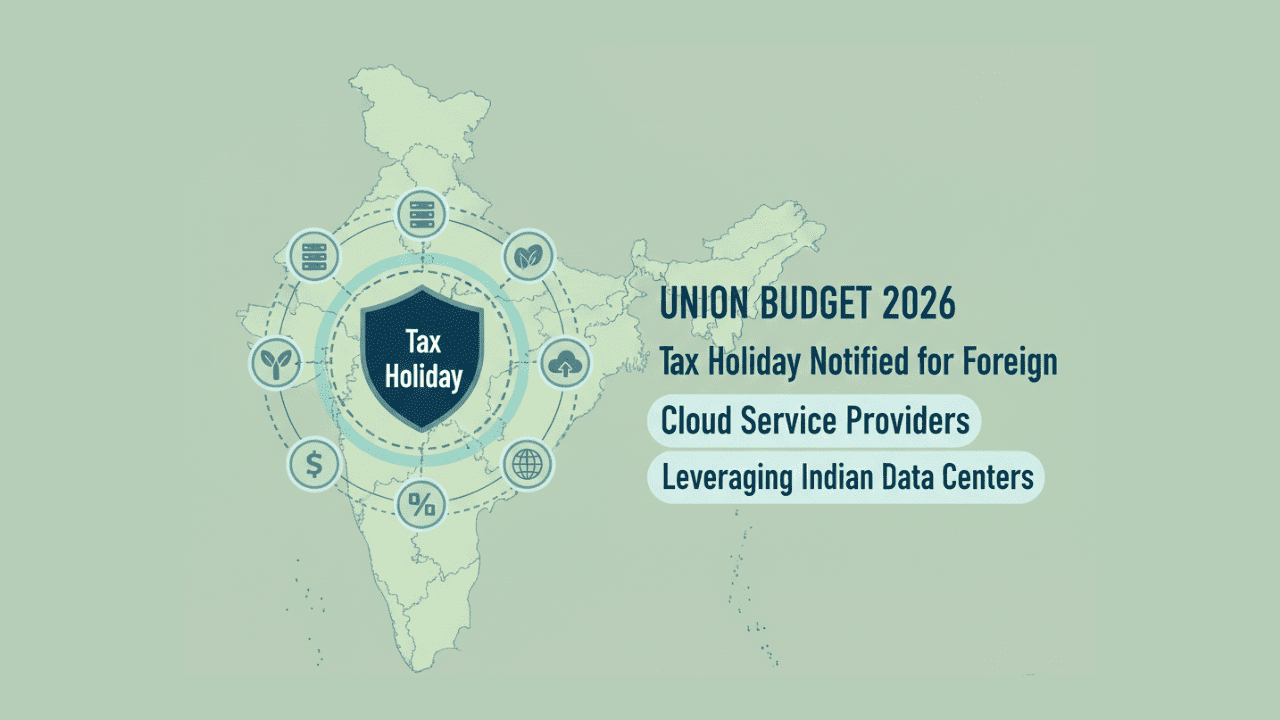
In a strategic move to position India as a global digital powerhouse, the Ministry of Finance has officially notified a landmark tax incentive for the cloud and data center industry. As part of the Union Budget 2026-27, a comprehensive tax holiday until 2047 has been granted to foreign companies that provide cloud services globally by utilizing data centers located within India. This 21-year policy horizon is designed to provide long-term fiscal certainty to global hyperscalers like Google, Microsoft, and Amazon Web Services (AWS), encouraging them to anchor their massive compute and AI workloads on Indian soil.
The notification serves to eliminate the long-standing “Permanent Establishment” (PE) risk. Previously, foreign cloud providers feared that hosting data or software on Indian servers could lead to their entire global income being taxed in India. This reform explicitly clarifies that procuring data center services in India will not create a taxable presence for a foreign company’s global operations, effectively making India a safe and attractive “compute hub” for the world.
Key Conditions for Eligibility
To avail of this tax holiday, foreign cloud service providers must adhere to a specific operational framework notified by the government:
- Global Service Provision: The foreign company must provide cloud services to customers worldwide using data center infrastructure situated in India.
- Notified Facilities: Services must be procured from data centers specifically notified by the Ministry of Electronics and Information Technology (MeitY).
- Indian Reseller Model: Any services provided to Indian customers by these foreign firms must be routed through a locally incorporated Indian reseller entity.
- No Physical Ownership: The foreign company must not own or operate the physical infrastructure or resources of the specified data center to qualify for the global income exemption.
Safe Harbour and Transfer Pricing
To further reduce litigation and simplify compliance, the Budget has introduced Safe Harbour provisions for related-party transactions:
- 15% Margin on Cost: In cases where the Indian data center is a related entity (e.g., a subsidiary or a captive unit) of the foreign cloud firm, a safe harbor margin of 15% has been set.
- Audit Certainty: If the Indian entity declares an operating profit of 15% on its costs, the tax authorities will accept the transfer price without detailed, time-consuming audits.
- Component Warehousing: A similar safe harbor of 2% on invoice value has been notified for non-resident firms storing critical server and network components in bonded warehouses in India, ensuring rapid maintenance and uptime for global fleets.
Economic Impact and Industry Reaction
The Finance Ministry projects that this move could catalyze over $200 billion in investments into India’s digital infrastructure by 2030. The policy shift reframes India’s role from being merely a consumer market to a global supplier of compute and storage capacity.
- Real Estate Surge: Industry experts anticipate a massive demand for large industrial land parcels, particularly in power-secure corridors like Navi Mumbai, Chennai, Noida, and Hyderabad.
- Level Playing Field: While domestic firms initially expressed concerns, the government clarified that profits earned from domestic activities (services to Indian customers or services provided by the data center to the foreign firm) remain fully taxable at standard corporate rates (25.17%), ensuring a fair competitive environment.
- Ancillary Growth: The expansion is expected to drive a 5x-6x increase in copper demand and significant upgrades to the national power grid, with data centers projected to consume 3% of India’s electricity by 2030.
Conclusion: A Vision for ‘Viksit Bharat’ 2047
The tax holiday until 2047 is more than just a fiscal concession; it is a declaration of India’s intent to be a pillar of the global digital economy. By providing a 20-year window of stability, the government is inviting global capital to build the “factories of the digital age” in India. This initiative ensures that the path to a $30 trillion economy is paved with high-tech infrastructure, localized AI capabilities, and a robust, globally integrated cloud ecosystem.